Sunday, 17 November 2019

"In Czechoslovakia, 10 days" 30 years of the Velvet Revolution

For the real question is whether the 'brighter future' is really always so distant. What if, on the contrary, it has been here for a long time already, and only our own blindness and weakness has prevented us from seeing it around us and within us, and kept us from developing it?

Vaclav Havel, The Power of the Powerless, 1978

Although it is often presented as such, the spectacular collapse of communist authority in East Germany, with the Berlin Wall and inner German border thrown wide open, was not the end of Soviet rule in Eastern Europe. The revolutions of 1989 came in waves, and were an unpredictable rollercoaster for those caught up in them.

The government of Czechoslovakia believed it could ride out the storm. A highly repressive society, even by Soviet-bloc standards, Czechoslovakia also had raw memories of the last time it had tried to ease the shackles of communist rule. The Prague Spring, a period of liberalisation in the mid-1960s, was met with a Warsaw Pact invasion in the summer of 1968. Ever since,

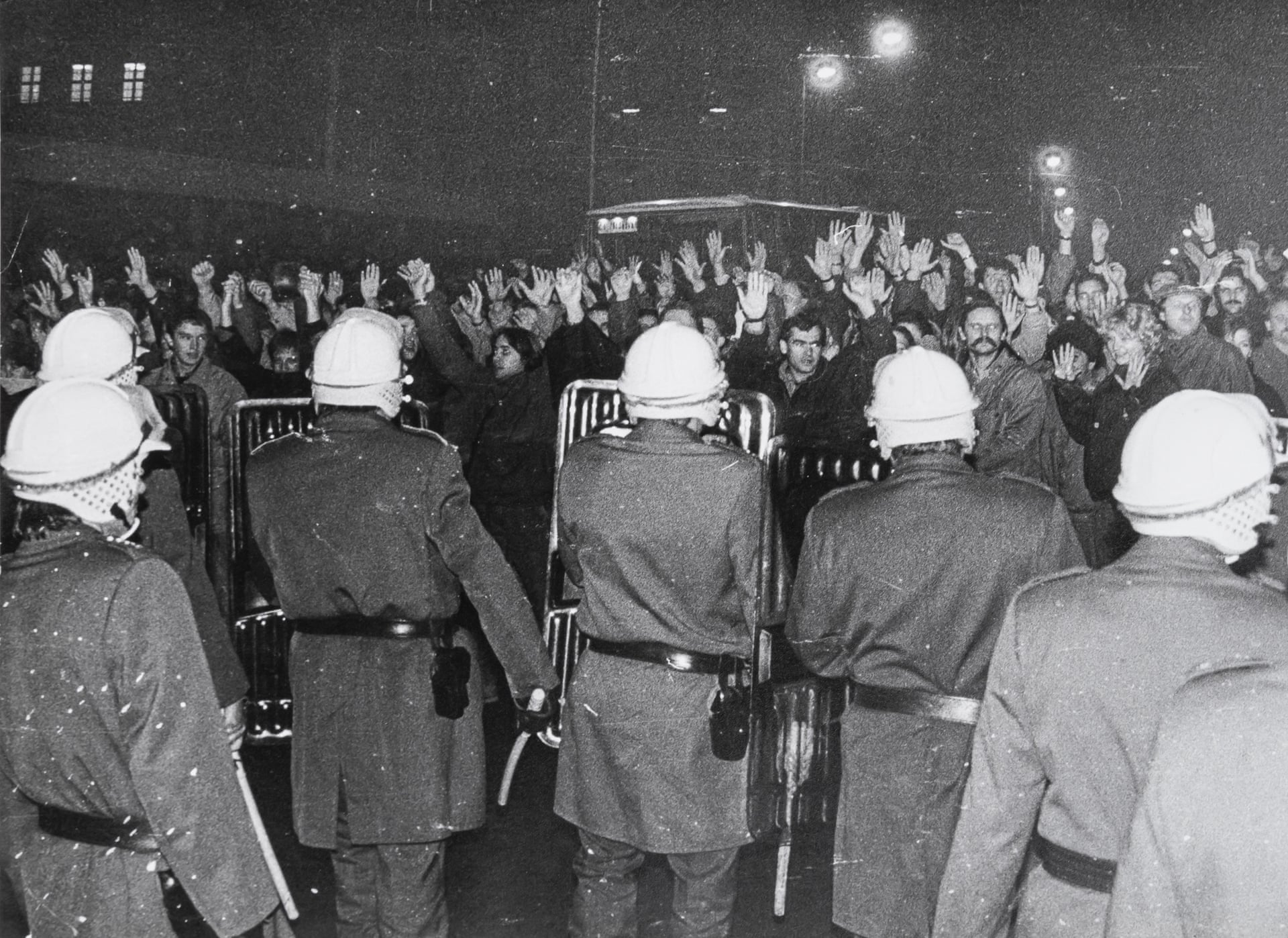
International Student's Day began in Czechoslovakia, marking a confrontation between Nazi occupiers and students at the Charles University on 17th November 1939. On 17th November 1989, students gathered in Prague to mark the event, and protest against the defiance of the Czechoslovak regime, which was stubbornly resisting change even as communist dictatorships collapsed around it. The Czechoslovak state responded in the only way it knew how. It sent in the riot police.

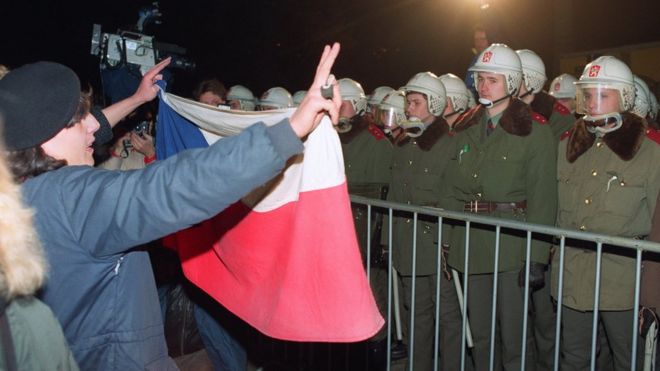
Czechoslovak riot police confront protesting students, 17th November 1989.

What exactly happened is still a matter of fierce debate. Rumours spread that a student was dead. Others later claimed he was an agent of the StB, the feared secret police, simply play-acting, to try and discredit the students. Others said he was simply overcome with emotion. What exactly happened is not important.

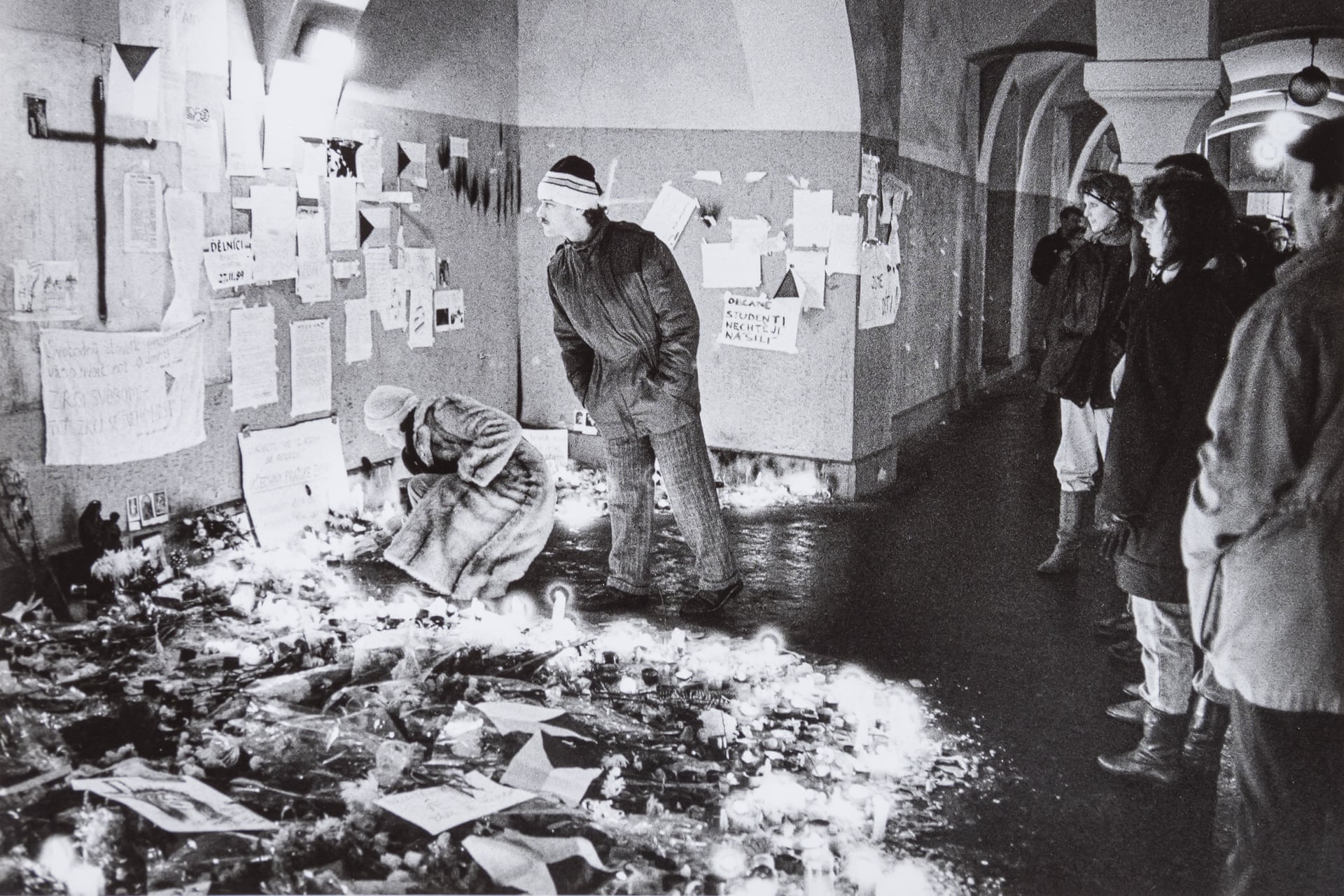
Memorial to the students, 23rd November 1989

What happened next is. Czechoslovakia had a long history of underground dissident thought. In the late 1970s, Charter 77 had been signed, committing dissidents to challenge the government on human rights grounds. In November 1989, it began to emerge from the shadows. The figurehead of the dissidents (although he hated that term) was Vaclav Havel, a playwright. He had spent most of the 70s and 80s in and out of jail for his plays and political essays. As rallies began to be held, and theatres and students went on strike, the cry went up: 'Send Havel to the Castle!' Prague Castle was the seat of the president. Two political bodies, Civic Forum and its Slovak sister Public Against Violence, sprung up out of nowhere to challenge the legitimacy of communist rule. The Churches threw their weight against the regime. And, most symbolically of all, the leader of the Prague Spring, Alexander Dubcek, left twenty years of internal exile and re-appeared on the scene, cheered enthusiastically wherever he went.

Protesters confronting Czechoslovak riot police, November 1989

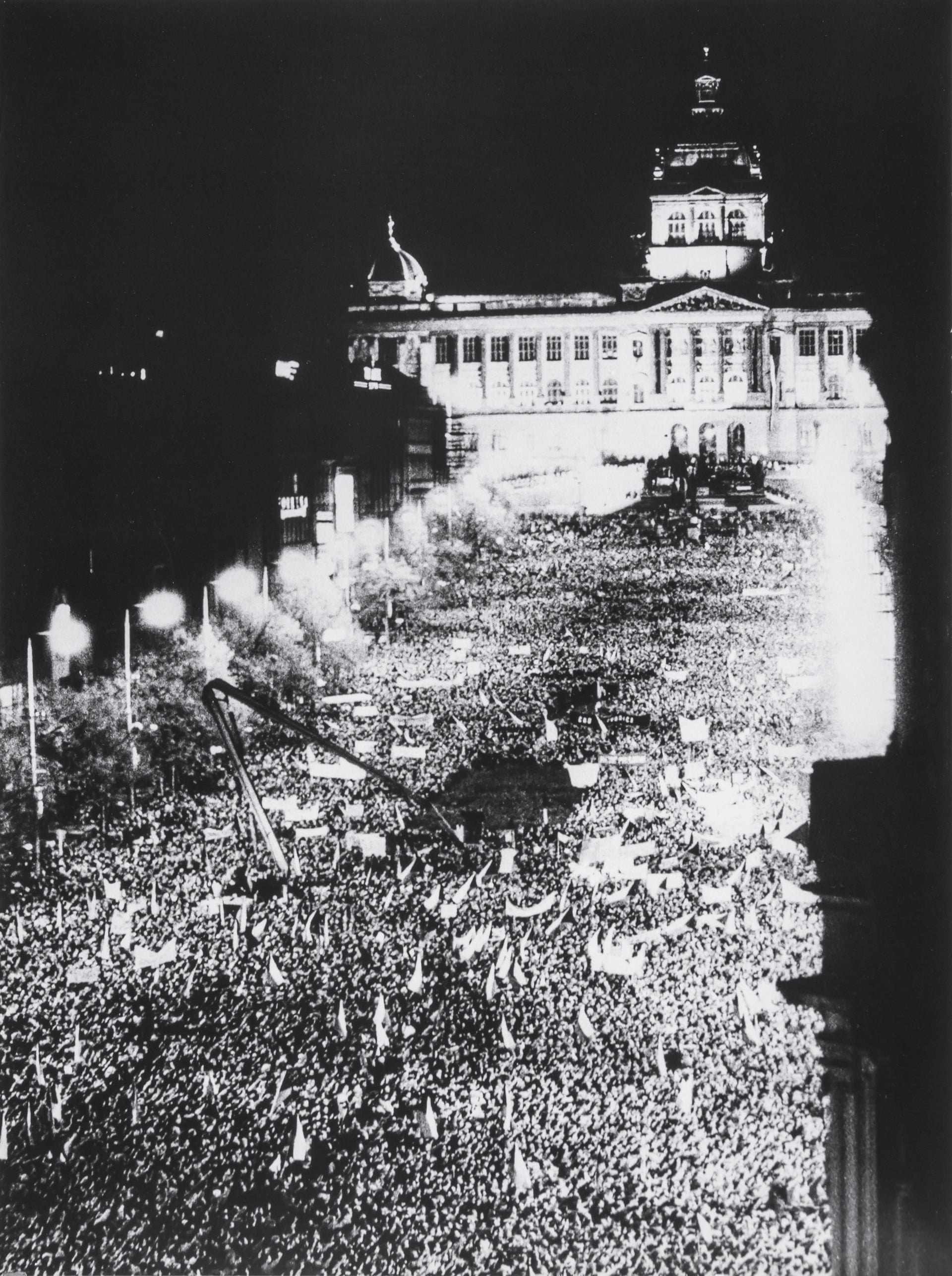
Rally in Wenceslas Square, Prague, 24th November 1989

In the end, it was all too much. On November 24th, the entire communist leadership resigned. Within a month, the communists had been ousted from government, and the demonstrators had got what they wanted: Havel was installed as President of Czechoslovakia.

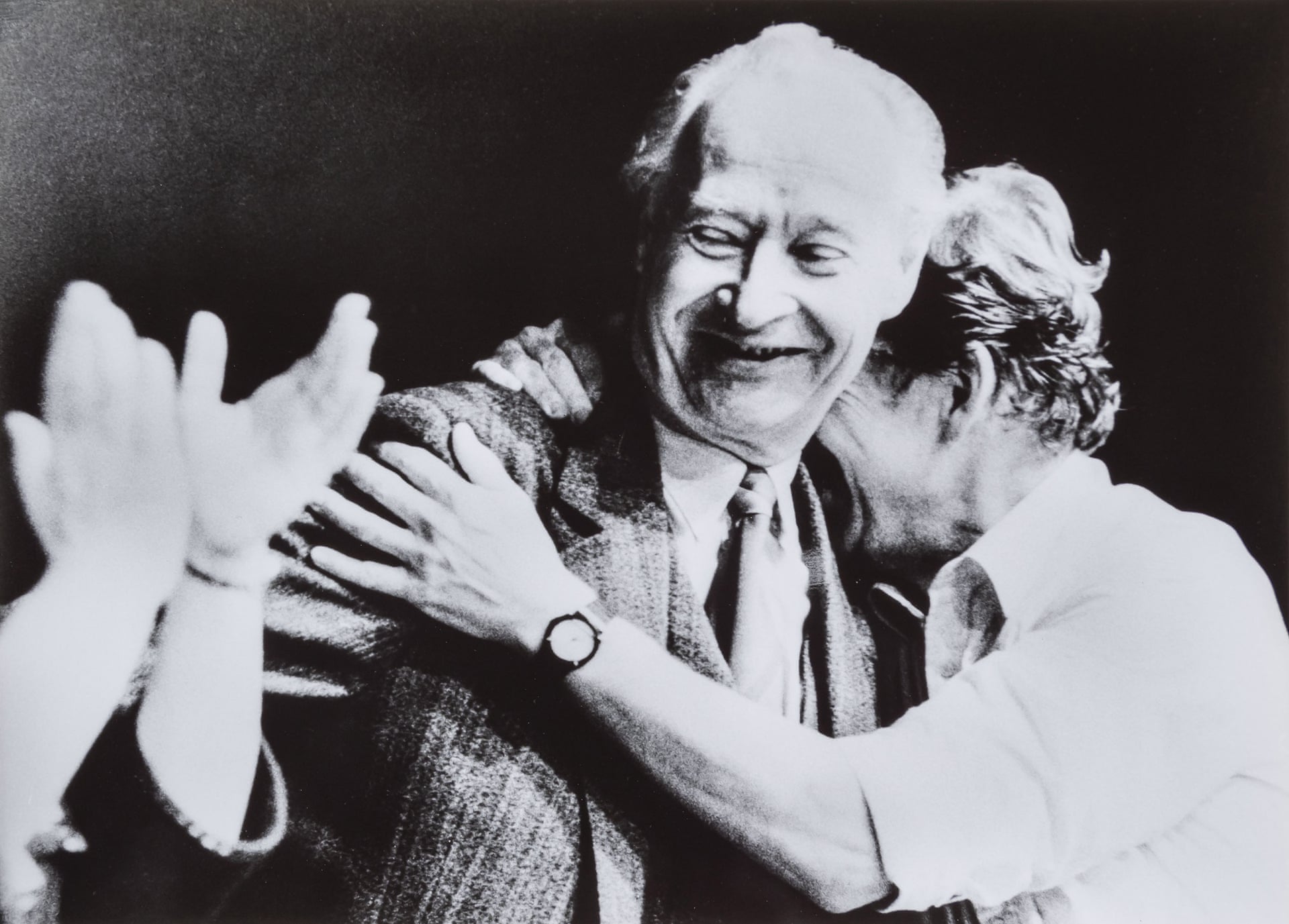
The once and future kings- Havel embracing Dubcek upon hearing that the communist leadership had resigned, 24th November 1989

The historian and journalist Timothy Garton Ash summed up the end of communist rule best:

In Poland it took 10 years; in East Germany 10 weeks; in Czechoslovakia 10 days.

Saturday, 9 November 2019

"As far as I know, it takes effect immediately, without delay": The fall of the Berlin Wall, November 1989

It was man who ended the Cold War in case you didn't notice. It wasn't weaponry, or technology, or armies or campaigns. It was just man. Not even Western man either, as it happened, but our sworn enemy in the East, who went into the streets, faced the bullets and the batons and said: we've had enough. It was their emperor, not ours, who had the nerve to mount the rostrum and declare he had no clothes.

John le Carre, The Secret Pilgrim, 1990.

The opening of the Berlin Wall, on 9th November 1989, wasn't the end of the Cold War. That was still over two years away. Neither was it the beginning of the end. That had begun, barely noticed, in the previous decade, when the cardinals of the Catholic Church had elected a Pole as the Vicar of Christ on Earth, thereby setting up the death knell of Polish communism and starting a contagion in the Eastern Bloc. The whole opening of the Berlin Wall turned out to have been a colossal, unplanned, blunder anyway, rather than a planned piece of historical theatre.

But it was the moment when it became obvious to the world how seismic the changes underway were. As the divided capital of a divided Germany, Berlin was the ultimate symbol of the Cold War. West Berlin was an island of capitalism amidst a sea of communism. It had been the flashpoint for earlier clashes between the USA and USSR, such as during the Berlin Blockade and Airlift of 1948-49, the ultimatum to leave in the early 1960s, the building of the Wall itself in 1961, and the tank standoff at Checkpoint Charlie that same year. When the inner German border was split wide open, in the autumn of 1989, it was clear that something momentous was underway.


Thursday, 3 October 2019

2019 in Books

Books read- 26
Pages read- 10,347
Target- 23
Numbers of new books- 26

Fiction/Non-fiction ratio- 3/4:23/22 (Arthur Clarke's collected works are a complex mixture of fact and fiction. Either way, another dreadful year for fiction)
Longest Book- Harold Wilson, Ben Pimlott, 811 pgs
Shortest Book- Utopia, Thomas More, 89 pgs
Quickest Read- Bad Astronomy, read 11th January
Longest Read- Gone Girl, 25th May to 24th December. However this was an audio book, only listened to on long journeys, so the actual longest read was Heretics and Believers: A History of the English Reformation, 28th January to 14th April.
Most Read Authors- Victor Sebestyen, on the origins of the Cold War (1946) and the ending of it (1989)
Ebooks- Heretics and Believers: A History of the English Reformation, Peter Marshall; Ælfred's Britain: War and Peace in the Viking Age, Max Adams; Utopia, Thomas More; Henry VIII and the Men Who Made Him, Tracy Borman; How Democracy Ends, David Runciman.
Audio books- The Spy and the Traitor: The Greatest Espionage Story of the Cold War, Ben McIntyre, Gone Girl, Gillian Flynn.
Useless Fact- I was one of 2.3 million people to log having read Gone Girl on Goodreads in 2019. I was one of 84 to log 1997: The Future that Never Happened. Clearly, a weird disappearance/murder in 2012 speaks more to people in 2019 than New Labour does...

The List
  • Æthelred the Unready, Levi Roach
  • Bad Astronomy, Philip Plait
  • 1946: The Making of the Modern World, Victor Sebestyen
  • Conquest: The English Kingdom of France, Juliet Barker
  • 1997: The Future that Never Happened, Richard Power Sayeed
  • Heretics and Believers: A History of the English Reformation, Peter Marshall
  • Report on Planet Three and Other Speculations, Arthur C Clarke
  • Power Trip: A Decade of Policy, Plots and Spin, Damian McBride
  • The Spy and the Traitor: The Greatest Espionage Story of the Cold War, Ben McIntyre
  • Days of God: The Revolution in Iran and its Consequences, James Buchan
  • Ælfred's Britain: War and Peace in the Viking Age, Max Adams
  • Black Tudors: The Untold Story, Miranda Kaufmann
  • Utopia, Thomas More
  • Henry VIII and the Men Who Made Him, Tracy Borman
  • Harold Wilson, Ben Pimlott
  • The Wars of the Roses: England's First Civil War, Trevor Royle
  • How Democracy Ends, David Runciman
  • The Power of the Powerless, Vaclav Havel
  • The Cold War: A New Oral History of Life Between East and West, Bridget Kendall
  • Thin Air, Michelle Paver
  • Richard III: Brother, Protecter, King, Chris Skidmore
  • Revolution 1989: The Fall of the Soviet Empire, Victor Sebestyen
  • Stasi Vice, Max Hertzberg
  • The Year 1000: What Life was Like at the Turn of the First Millennium, Robert Lacey & Danny Danziger
  • Gone Girl, Gillian Flynn
  • The Nazis: A Warning from History, Laurence Rees


Tuesday, 3 September 2019

The Wit and Wisdom of... Thomas More

I follow my conscience; you must follow yours.

My conscience satisfies me, and now I will speak plainly, that your statute is faulty and that your authority baseless.

My conscience holds with the majority, which makes me know it does not speak false. 

Against Henry’s kingdom, I have all the kingdoms of Christendom. Against each one of your bishops, I have a hundred saints. Against your one Parliament, I have all the General Councils of the Church, stretching back for a thousand years.
Read more: https://www.springfieldspringfield.co.uk/view_episode_scripts.php?tv-show=wolf-hall-2015&episode=s01e04

Sir Thomas More, speaking before he was sentenced to death for refusing to take the Oath of Supremacy and acknowledge Henry VIII as Supreme Head of the Church, as imagined by Hilary Mantel in Wolf Hall

Sunday, 1 September 2019

The Wit and Wisdom of... Edward R Murrow

Earlier, the senator asked, "Upon what meat does this, our Caesar, feed?" Had he looked three lines earlier in Shakespeare's Caesar, he would have found this line, which is not altogether inappropriate:

"The fault, dear Brutus, is not in our stars, but in ourselves."

... We must not confuse dissent with disloyalty. We must remember always that accusation is not proof and that conviction depends upon evidence and due process of law. 

We will not walk in fear, one of another. We will not be driven by fear into an age of unreason if we dig deep in our history and our doctrine, and remember that we are not descended from fearful men. Not from men who feared to write, to speak, to associate, and to defend causes that were, for the moment, unpopular.

This is no time for men who oppose Senator McCarthy's methods to keep silent, or for those who approve. We can deny our heritage and our history, but we cannot escape responsibility for the result. There is no way for a citizen of a republic to abdicate his responsibilities.

As a nation we have come into our full inheritance at a tender age. We proclaim ourselves, as indeed we are, the defenders of freedom, wherever it continues to exist in the world, but we cannot defend freedom abroad by deserting it at home.

The actions of the junior senator from Wisconsin have caused alarm and dismay amongst our allies abroad, and given considerable comfort to our enemies. 

And whose fault is that? Not really his. He didn't create this situation of fear. He merely exploited it, and rather successfully. 

Cassius was right. 

"The fault, dear Brutus, is not in our stars, but in ourselves."

Good night, and good luck.

US Journalist Edward R Murrow, 'A Report on Senator Joseph R McCarthy,' 9th March 1954. 

If you ignore the bits that are obviously contextual to 1950s Red Scare America, there are huge chunks that apply to us in Britain today.

For best impact, it has to be heard in Murrow's voice:


Or, David Strathairn playing Murrow in Good Night, and Good Luck:

Thursday, 29 August 2019

The UK's biggest ever democratic exercise... isn't the Brexit vote.

Labour are pushing for a divisive second referendum which rips up their manifesto pledge to respect the result of the largest democratic exercise in our nation’s history and would take us back to square one.

The wisdom of Brandon Lewis, Tory MP and Home Office minister, there. It is a claim you hear a lot now. The UK's decision to leave the EU was a democratic exercise like no other, unparalleled in its scope and size, and so we absolutely must go along with it.

Luckily, this is very easy to test. There are two ways to gauge the size of an election. The turnout, and the number of votes cast. Here are the figures for the EU referendum:

2016 EU membership- 72.2%, 33,577,342

Sounds a lot, especially when compared to the only two other UK-wide referendums ever held:

1975 EEC membership- 64.6%, 25,903,194
2011 Alternative Vote- 42.2%, 19,279,022

Hands down, then. Brexit wins. It is miles clear in terms of both turnout and number of votes cast.

But referendums are very rare political events in the UK. We are far, far more used to thinking of democracy in terms of general elections. And here the 2016 referendum starts to look less outstanding:

General elections, 1945-2017 (I picked '45 as it is when a recognisable political landscape emerged).

1945- 72.8%, 24,073,025
1950- 83.9%, 28,771,124
1951- 82.6%, 28,596,594
1955- 76.8%, 26,759,729
1959- 78.7%, 27,862,652
1964- 77.1%, 27,657,148
1966- 75.8%, 27,264,747
1970- 72.0%, 28,305,534
1974 (Feb)- 78.8%, 31,321,982
1974 (Oct)- 72.8%, 29.189,104
1979- 76.0%, 31,221,362
1983- 72.7%, 30,671,137
1987- 75.3%, 32,529,578
1992- 77.7%, 33,614,074
1997- 71.4%, 31,286,284
2001- 59.4%, 26,367,383
2005- 61.4%, 27,148,510
2010- 65.1%, 29,687,604
2015- 66.1%, 30,697,525
2017- 68.7%, 32,204,124

By this measure, the EU referendum is either the second largest democratic exercise in terms of raw number of votes cast (behind the 1992 election), or the 14th in terms of turnout (behind every post-war election apart from 1970, 2001, 2005, 2010, 2015, and 2017). It is impressive compared to recent participation in general elections. But it hardly seems worth being the hill that we die on as a nation.

There is another claim that is made, that the Brexit vote represents the largest mandate for anything in British democratic history. This seems more credible. Certainly, more people voted for Brexit than for any other single option. But, it is very hard to compare the mandates received from general elections to one that is derived from a referendum. General elections produce majorities in the House of Commons, referendums do not. Prime Ministers do also receive shares of the vote, and total number of votes, but these reflect the multiple choices on offer across the UK. John Major holds the record for the most votes cast for his party, at 14 million in 1992, but this translated into 41.9% of the vote. The largest post-war vote share was Anthony Eden in 1955, at 49.7%, but was 'only' 13.3 million votes (fewer than both Labour and the Tories at the previous election).

Referendums are generally measured on the size of the winning vote share; the greater the winning vote share, the better the result, the more legitimacy it contains. And now 2016 is looking like it is in serious trouble:

1975 EEC membership- Yes- 67.23%, No- 32.77%
2011 Alternative Vote- No- 67.9%, Yes- 32.1%
2016 EU membership- Leave- 51.89%, Remain- 48.11%

For the record, it doesn't stand up well against the sub-national referendums we've either:

1973 Northern Irish 'border poll' (on whether to unify with the Republic of Ireland)- Remain in the UK- 98.9%, Join with the Republic of Ireland- 1.1%
1979 Scottish devolution- Yes- 51.62%, No 48.38% (failed as the rules said a certain percentage of people needed to vote for it, and 51.6% was too low)
1979 Welsh devolution- No- 79.74%, Yes- 20.26%
1997 Scottish devolution- Yes- 74.29%, No- 25.71%
1997 Welsh devolution- Yes- 50.3%, No- 49.7%
1998 Northern Ireland Good Friday Agreement- Yes- 71.1%, No- 28.9%
2011 Welsh further powers devolution- Yes- 63.49%, No- 36.51%
2014 Scottish independence- No- 55.3%, Yes- 44.7% (Which, incidentally, saw a whopping 84.6% turnout, a level of participation way above that of even national elections in the 1950s).

So although more people voted for Brexit than any of the above, it does not command the same proportion of popular support as keeping Britain in the EEC, keeping first past the post, keeping Northern Ireland in the UK, enacting or furthering Scottish and Welsh devolution, keeping Scotland in the UK, or signing the Good Friday Agreement. It has the third weakest mandate of the UK's referendums, coming ahead only of implementing Welsh devolution in 1997 and Scottish devolution in 1979. The 2016 Brexit vote was 27.9 percentage points behind the largest mandate, rejecting Welsh devolution in 1979. Ironically, this is an issue that the electorate were allowed to change their minds on. (Leaving out the extraordinary vote on the Northern Irish border in 1973, where the poll was boycotted by nationalists, so those voting those who'd vote for heavily for the Union anyway).

Ironically, the Brexit vote is highly likely to undo many of these policies, as leaving the EU is likely to trigger Scottish independence and destroy the Good Friday Agreement, potentially leading to a united Ireland. Despite those things arguably having a greater popular mandate than Brexit.

As a final aside, it turns out that the policy which has the second most votes ever in British history is the decision to remain a member of the EEC, from the 1975 referendum. In fact, the difference between the two is a pathetic 32,000 odd votes. And yes, I hope the colossal irony is not lost that the 2016 referendum marks an overturning of the wishes of voters from 1975. In what could be called a second referendum on the same subject.

To finish. The 2016 referendum is not the largest democratic exercise in British history, neither in terms of turnout nor of raw votes cast; those belong to the 1950 and 1992 elections respectively. It is more accurate to say that more people voted for Brexit as a single option. But how this translates into a mandate is a tricky bit of political science. And shouldn't be bandied about carelessly. Especially when other decisions, decisions that were endorsed by separate referendums, are going to be torn up as a result.

I'll leave you with the strangest fact of all. The UK's largest democratic exercise ever was the 1992 election, with the most votes cast, and a record 14 million votes for the winning Conservatives. There is something disconcerting that, if we applied the logic of the 2016 referendum to general elections, John Major would still be Prime Minister today.

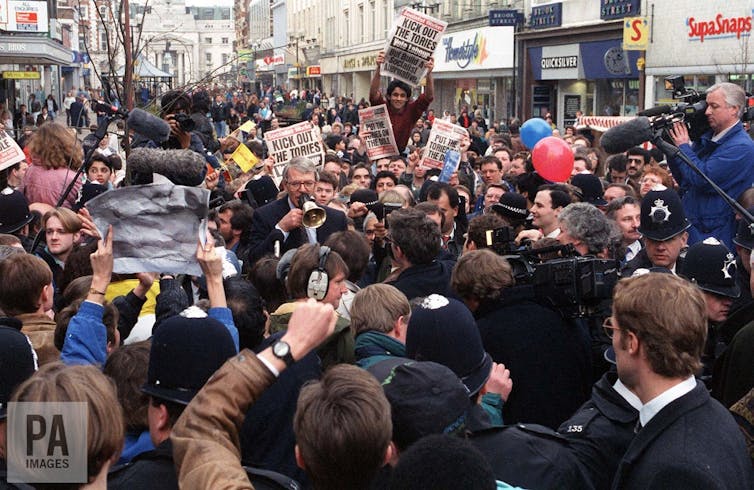
The true beneficiary of Britain's largest democratic exercise, campaigning in Luton, 1992

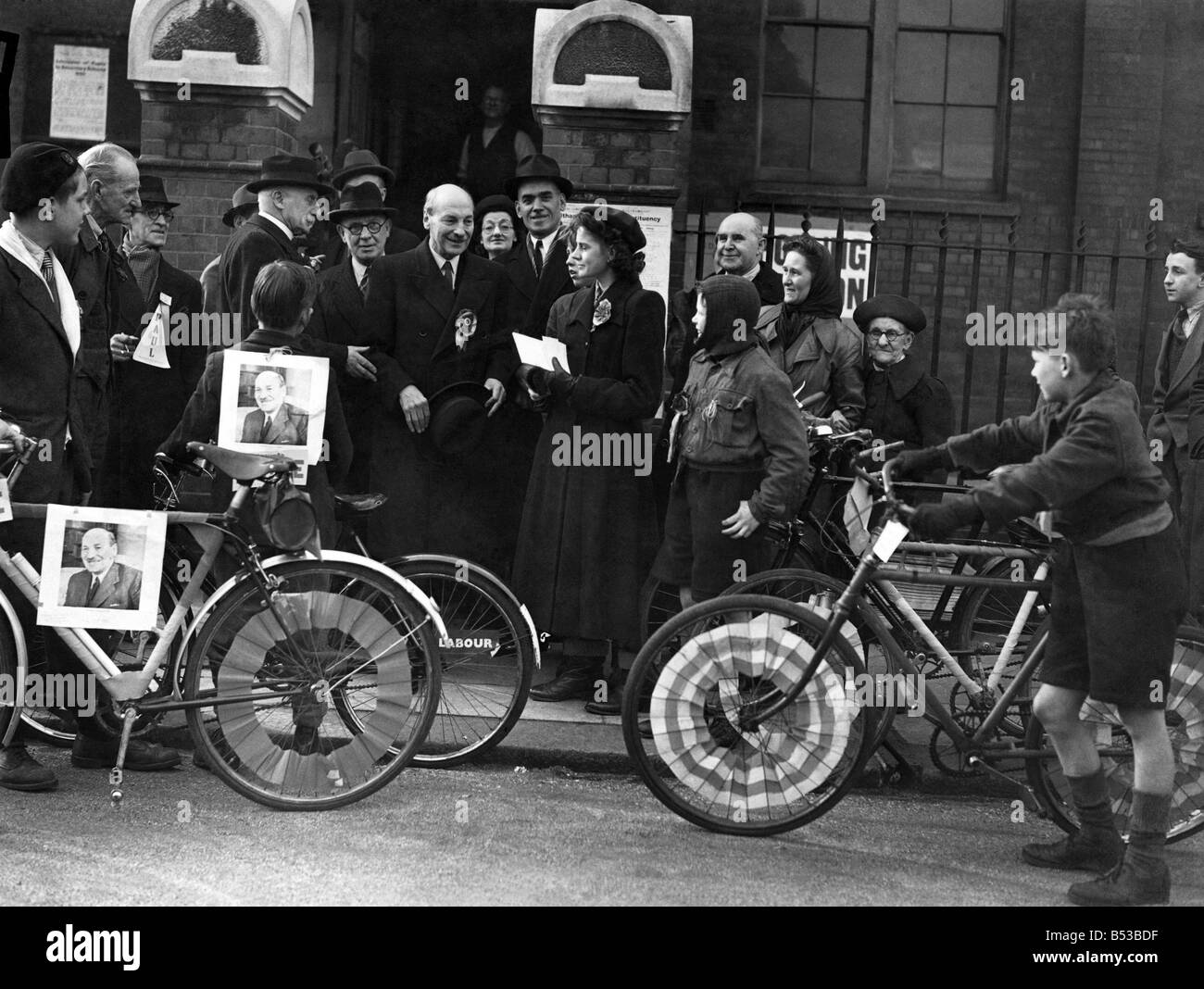
Clement Attlee voting in the 1950 election, which saw 83.9% of the electorate take part, the other contender for Britain's largest democratic exercise.

The idea for this blog came from this article: https://fullfact.org/europe/eu-referendum-not-largest-democratic-exercise/

Wednesday, 14 August 2019

"A devil of a job to get it out:" The Army goes in to Northern Ireland, 1969

In August 1969, the Republican Labour MP for West Belfast, Gerry Fitt, found himself taking shelter with some of his constituents in a shop along the Falls Road in Belfast. Outside, there was chaos. Northern Ireland was teetering on the brink of a total collapse in law and order. Clashes between Unionists and Nationalists were blighting every major town and city. The Royal Ulster Constabulary was widely perceived to be taking the side of the unionists; rather than suppressing the disorder, they were fuelling it. People were being forced from their homes, in scenes more akin to a pogrom than a riot in post-war Britain. 

Fitt's constituents begged him to use his influence with the Home Secretary, Labour's James Callaghan, to do what had been done in Derry several days previously, and send in the British army to keep the two sides apart. So Fitt used the phone in the shop to talk to Callaghan, and told him what the people wanted. "Gerry,' Callaghan replied, "I can get the army in, but it will be a devil of a job to get it out."

It is one of those historical occurrences that is a bit too neat, written with the benefit of hindsight. But it accurately reflects the contradictions and consequences of the events in the summer of 1969, when Britain sent troops to Northern Ireland.

The partition of Ireland in the 1920s had left deep scars. Northern Ireland was a predominantly Protestant and unionist polity, and the Ulster Unionist Party reigned supreme. "A Protestant Parliament for a Protestant people" ran the saying about the local government at Stormont, and it was accurate. Despite accounting for nearly a third of the population, the Catholic and nationalist population suffered from being treated as second-class citizens; it was harder for them to vote, and they took second priority in terms of jobs and housing. The security apparatus of the new state, the unionist dominated RUC and the B-Specials reservists, took a hardline on policing. Understandably, for they had seen their predecessors in British Ireland taken apart by the IRA, whose spectre haunted the newly partitioned state. This state of affairs persisted from the 1920s until the mid-1960s, with little attention from Britain, let alone the rest of the world. With its own Parliament and Prime Minister, Northern Ireland had a huge level of autonomy, and British politicians saw no need to upset the status quo. But with the birth rate in the nationalist community outpacing the unionist birth rate, this was a house built on sand.

It was events on the other side of the world that began to make the sands shift. In the Deep South of the USA, the struggles of the civil rights movement, standing against the segregationist Jim Crow laws, were beamed around the world, and held up as a symbol of the 1960s. This infectious air of progress through peaceful means caught on in Northern Ireland. In 1967, the Northern Irish Civil Rights Association, formed of a coalition of left wing groups, began to campaign for fairer voting, reform of the police, and an end to discrimination in jobs and housing. From 1968, they began to stage a series of marches across Northern Ireland.

The reaction of many unionists was little short of hysteria. They warned that to concede on these measures would start Northern Ireland on a path that would end with Irish unification, which would see the end of their way of life. They also claimed that the NICRA had been infiltrated by the IRA. This was true, but only as the IRA had pretty much abandoned the armed campaign and had committed its members to this venture to try and achieve Irish unity. The figurehead who emerged as the leading voice (ironically, as he was so loud) of the hardliners was Ian Paisley, the firebrand Protestant minister. Doubly ironically, it was Paisley's rhetoric that breathed new life into the loyalist paramilitary organisations, who prepared to defend their way of life by force.

In late 1968, a civil rights march went ahead despite being banned by the Northern Irish government. The RUC set on the march, and many were badly injured. The footage that emerged from the march looked very similar to the actions of the police in the American Deep South. In response, the Prime Minister of Northern Ireland, Terence O'Neill, introduced a mild package of reforms to meet the demands of the NICRA. But so febrile was the atmosphere that loyalist unionists cried treachery. An election called by O'Neill saw the Ulster Unionist Party split badly on the issue, and he was forced to resign. At the same time, a by-election to Westminster was won by Bernadette Devlin, only 21 years old, standing on the Unity ticket, which supported the NICRA. The outside world was beginning to notice that something was rotten in the state of Northern Ireland.

Which brings us to the summer of 1969. In Derry, a city so divided that even the name is politically contentious, a march to commemorate a Protestant victory in a battle in Irish history was held on August 12th. The march happens every year, but in this atmosphere it was a spark that ignited a tinderbox. Police clashed with citizens around the edge of the heavily Catholic Bogside area. Barricades were erected, and the police, joined by unionist civilians, got into running battles with nationalists. Tear gas was met with petrol bombs. In areas which were more mixed, families from the minority were forced out of their homes, which were destroyed. The RUC, badly out of its depth, called up the hated B Specials, which sent more fear through the Catholic community. The unrest began to flare up in Belfast, and other areas.

All of this was taking place in full view of the world's media, on the streets of a major Western democracy. The pressure to act was immense. Harold Wilson, Britain's Prime Minister, discussed with James Callaghan their options. If the government of Northern Ireland asked for help, it would be given, providing there were more reforms to meet the demands of the protesters. James Chichester-Clark, the new Prime Minister of Northern Ireland, bowed to the inevitable, and requested help from the British government. The army was sent to Derry on August 14th, and arrived in Belfast a few days later.

In light of later developments, the reactions seem bizarre. Many unionists detested the interference by the British government in their own affairs, especially when it was forcing them to make concessions. Dublin was furious at the move, but totally powerless to do more than complain. As for the protesters themselves, they were delighted with a more impartial face of law and order. "We've won, we've won, we've brought down the government" went the chant from the barricades. There are many stories of British soldiers being brought tea and cakes. After all, the soldiers had actually come to protect them, unlike their supposed saviours. 'I Ran Away' was graffitied all over Catholic areas, and contempt for the paralysis in the moribund IRA was widespread. The soldiers patrolled openly, with berets and safety catches on. The commander of the soldiers was delighted with the deployment, as he had heard that Northern Ireland's golf scene was second to none.

There were voices in the summer of 1969 that predicted the recent spate of violence would not be stopped by the arrival of British soldiers, and in fact would get worse. Callaghan and Wilson were under no illusions as to what they had done. The army knew that without a real political drive towards conciliation, the soldiers would soon be caught in the middle of an ugly conflict. And the events of 1969 did lead to a hardening of attitudes on both sides. On the unionist side, there was outrage that even the British government was forcing them to make concessions to the nationalists. For the nationalists, the reforms that accompanied the soldiers were nowhere near enough, and the soldiers soon came to be seen as part of the unionist state. The deployment of British troops caused a crisis in the IRA. It split, with those who wanted it to actually do something leaving and creating a new organisation dedicated to taking the fight to the British, the Provisional IRA. The seeds of the sectarian chaos of the early 1970s was being sown.

James Callaghan probably did not speak to an embattled Gerry Fitt over the phone in August 1969. But the anecdote perfectly encapsulates the possibilities and problems which existed in the deployment of British soldiers to Northern Ireland.

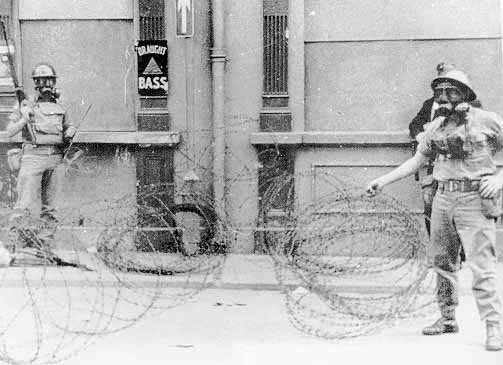
Soldiers from the Prince of Wales Regiment deployed on the streets of Derry, 14th August 1969
https://canvas-story.bbcrewind.co.uk/sites/usatc/ This site is an excellent summary, with pictures and archive video, of the story I have tried to tell.