Wednesday, 19 April 2017

Oklahoma City

The time is 09:02. The date is April 19th, 1995. In Oklahoma City, in the heart of America, a truck bomb detonated beneath an office building used by the federal government. A third of the building collapsed in the explosion. Among the 168 dead were 19 children; the bomb had been placed beneath the creche. It was then the largest terrorist attack in American history, and today has only been surpassed by the unparalleled September 11th attacks.

As the news of the carnage came in, many pointed to the Middle East. The attack had all the hallmarks of recent atrocities in Palestine and Lebanon. After all, it was Middle Eastern terrorists who had bombed the World Trade Centre in 1993. The US President, Bill Clinton, was urged to close down US airports, to stop those responsible from escaping the country. The biggest question was why on Earth these killers had travelled all the way to Oklahoma.

And then someone looked at the date. April 19th.

In 1993, federal law enforcement agents had got into a showdown with an extreme Christian cult in Waco, Texas. The cult leader, David Koresh, was amassing weapons for the end of the world, which he believed was soon. He was also accused of abusing the children in the compound; Koresh was practising polygamy. When law enforcement agents attempted to seize the weapons, the cultists fired on them. This led to a long stand-off between the FBI and those inside. With no end in sight, the FBI began to try and force their way in on April 19th, 1993. The building burnt down, set on fire by Koresh and his followers. 76 people burnt to death.

The Waco siege, along with another armed standoff at Ruby Ridge in 1992, became celebrated causes on the American right. Many saw the federal government as their enemy, and elements of the Christian right began to claim that the end of days would come in a conflict between citizens and the federal government. Fed by talk radio hosts, this toxic atmosphere fed into mainstream politics. In 1994, the Democrats were hammered at the midterm elections by the Republicans, who brought a hard-edged, obstructionist rightist politics into Washington DC. The federal government was blamed as the cause of all ills, and treated as beneath contempt.

One of those influenced by this tide of bile was Timothy McVeigh, an army veteran who had come to mistrust and hate the government. Driven by the chorus of voices claiming that something had to be done, McVeigh did just that, packing a truck full of explosives and fertilisers, and parking it underneath the Alfred Murrah building.

The person intent on bringing death and misery had not traveled 'all the way to Oklahoma.' He'd driven up the road.

What is the point of marking this anniversary? The Oklahoma City bombing stands as a warning to us all. When you create a toxic atmosphere by bashing others, whoever they may be, you bring a moment like this nearer. When you dehumanise people, you make it easier to justify extreme measures against them. When you issue a call for action, those who are troubled, disturbed, or full of anger and hatred may well respond to your calls. Last year, a Labour MP was shot dead in the streets of her own constituency, by a person with far-right views, who shouted "Britain First" as he carried out his attacks. The media and political screams of 'Take Back Control' during the EU referendum had played out in awful terms.

As we prepare to go through yet another fractious election campaign, remember that. Remember that words can have consequences. And sometimes those consequences can be utterly horrific.

If you want to find out more about the 1995 Oklahoma City bombing, I cannot recommend this documentary enough:


Tuesday, 18 April 2017

Another Election? We could try these instead...

As we're plunged back into the campaign trail, many in Britain are bemoaning that we're being asked to vote *again*. So, here is a whistle stop tour through history to see what some of our better alternatives have been...

Roman Empire

Back in the good old days, things were much easier. If you fancied having a stab at being emperor, you got your soldiers to proclaim you. Easy really.

I mean, there was then the small issue of then fighting off all the others who had done the same, and then holding power against all those who tried to do the same to you. But it was a very meritocratic system, and these days there is a lack of social mobility, so definitely something to consider.

Anglo-Saxon England

Two possible variations here. The Anglo-Saxon king of the English was semi-elective; in theory the Witan (the collection of powerful Earls and bishops who advised the king) could chose whoever they wanted to be king. In practice it was normally the son of the previous monarch. Not always the eldest son, mind you. Sometimes brothers got a look in, even when there were children still alive. Alfred the Great only became king of the West Saxons after three of his brothers had been king. Alfred's son, Edward the Elder, later had to see off a rebellion by his cousin, Æthelwold, who made a bid for power on Alfred's death in 899; Æthelwold used the fact that his father had been king before Alfred to legitimise his bid for power. Sons born to the sitting king often jumped the order of precedence over any children he'd had before he became king.

The elective nature of the Anglo-Saxon kingship is perhaps best seen in the crisis of 1066. Edward the Confessor died childless, and the nearest related member of the House of Cerdic was only a child. Instead, the Witan elected Harold Godwinson as king, off the back of his military and governing experience. The flaw in this system is also shown in 1066; once you've established the idea that anyone can become king, anyone can give it a shot. And so it was that William the Bastard, the Duke of Normandy and a distant relative of the Anglo-Saxon monarchy, launched a long shot bid for the throne. Harold Godwinson went down to defeat at Hastings, and the rest, as they say, was history.

The Holy Roman Empire

The Holy Roman Emperor was chosen by an electoral college, made up of three bishops and four princes. The winner (who was always magically the son of the previous Emperor) was then crowned by the Pope (until 1530, at any rate). An electorate of seven people is a hell of a lot easier to talk to directly, and the rest of us can get on with our lives without having to worry about all these important things. It'd certainly make political advertising much simpler.

But this was only from the late Middle Ages onwards. Charlemagne was crowned Emperor of the West by the Pope during Christmas Day Mass in 800, apparently without any warning. Still I reckon he'd have settled for a new jumper or something. Must have been pretty awkward, as I don't think he'd bought the Pope anything in return.

The first US Election

The framers of the US Constitution had a very clear idea of who the first president was going to be. Only George Washington could bridge the gaps between the various segments in American society that had emerged under the original system of government that had bumbled along since independence from Great Britain. And so once he agreed to have the job, the actual election was a formality. No one ran against him, any many states just nodded the approval through. Washington certainly didn't do anything as unseemly as campaigning for the job or anything. How times differ...

Modern Papal Elections

You lock 120 elderly men inside an art museum, and when 2/3 of them agree on a replacement, they start a fire to signal to the outside world they can be let out. But it's ok as the Holy Spirit keeps an eye on things.

No, really.

Shadowy Conspiracy Government

I am still wading my way through The X-Files. Every few episodes, there is a smoky, shadowy room shown. From this room, a cabal of rich men direct world affairs from behind the scenes. They alone know what is good for the world. The democratic facade they allow to continue is not that actually wields any power.

Now, leave aside how easy it would be to read some dreadful anti-Semitism into this. Or how quaint it is that these people rig elections with ease, but are seemingly incapable of finding Mulder at any given point without visiting Scully and asking her.

No, look at the world around you. Switch on the TV. Open the BBC News website. Does this look like a world that is being organised and planned?

Nope, didn't think so. I'd highly recommend Jon Ronson's book Them: Adventures with Extremists. You'll soon be worrying more about the people who believe this than those apparently running the show...

Which leaves...

There is an awful quotation, attributed to many of the usual suspects, that says that democracy is the worst form of government, apart from all the others we've tried. Well, perhaps.

And we have tried many others. Not just the weird and wonderful systems outlined above, but corrupt oligarchies, restricted democracies, and despotic dictatorships. None has served the common good well. None has benefitted ordinary men and women.

But government of the people, by the people, and for the people, as Abraham Lincoln really did say, ensures a say in the future by each and every one of us. Yes, we may be fed up of elections. Yes, we may be unsure of the ability of the individual to shape the process.

But unless you want you future determined by clerics, soldiers, people who claim they are gods, or David Icke's lizards, then you are stuck with democracy and elections. Make the most of it. Many of those who came before us weren't even given this tiny say in their futures.

Register, and wait for June 8th. Then go out and have your say. Because you're bloody lucky to have the chance to go and do so. Lizards or not.


Here We Go Again...

And today was supposed to be a productive day. I was going to do some marking, some planning, some cleaning.

And then Theresa May decided to go and ruin it by announcing that she was calling a general election for June 8th.

For those of us on the left, be it in the disintegrating Labour party, the shattered remains of the Liberal Democrats, the idealistic cocoon of the Greens, or floating somewhere in between, there can only be one reaction to this announcement:


The good news is that, unlike 2015, there won't be a shock outcome. Unlike 2010, there won't be a chance after the election to keep the Tories out. Even if the Lib Dems make gains (as predicted), the collapse of Labour will put Theresa May back into Number 10, possibly with a majority of over a hundred. Labour will almost certainly do worse than they did in 1983, under Michael Foot, when they slid to 209 MPs. They may even drop to the total that John Major got in 1997, 165 survivors of the Blair landslide. There are whispers they may go below that. 

If you care about progressive politics, or even having a functioning opposition to the government, this election could be a bleak milestone. Brexit aside, the vision that May has laid out in the last few months has been ugly and regressive. And it is about to be endorsed by millions.

I normally relish elections. They're what politics junkies live for. But not this one. I cannot see any light at the end of the tunnel. This is going to be a bloodbath. Let's get it over and done with.

Wednesday, 29 March 2017

How Long the Night?

Myrie it is while sumer
ylast with fugheles song.
Oc nu neheth windes blast
and weder strong. Ei, ei!
what this nicht is long. And
ich with wel michel wrong
soregh and murne and
fast.

It is pleasant, indeed, while the summer lasts
with the mild pheasants' song ...
but now I feel the northern wind's blast—
its severe weather strong. 
Alas! Alas! This night seems so long!
And I, because of my momentous wrong,
now grieve, mourn and fast.

How Long the Night, c.13th century English poem.

Wednesday, 15 February 2017

Rockin' in the Free World?

Since November, I've noticed a trend. The American presidency is once again being referred to as the 'Leader of the Free World.'

This is an expression with a long history. It first emerged in the Second World War, when American and British propaganda proclaimed that the conflict was a grand struggle between the 'free world' and the tyranny of Nazism. This did rather gloss over the fact that the largest contribution to defeating Nazi Germany was the USSR, a totalitarian dictatorship, led by a paranoid megalomaniac. In a fairer world, someone at the time would have pointed out the similarities between Joseph Stalin and Adolf Hitler...

But, as the victorious Allies looked down on the ruins of the conquered Nazi state, the expression lingered. Within a few years, it became obvious that the Soviet promises of open and fair elections in Central and Eastern Europe were worthless. By 1949, the countries of Western Europe and North America had created a military alliance, NATO, to oppose Soviet expansionism. But the world was much bigger than the North Atlantic, and so the 'free world' became shorthand for US allies. And, by virtue of his position as the elected head of state in the USA, the President of the United States became known as the Leader of the Free World.

To push the claim of the United States to take global leadership in opposition to the communist bloc, the phrase was heavily used in American foreign policy rhetoric. The American allies who fought in Vietnam were even grouped together as the 'Free World Military Forces.'

And in a way, it made sense. The lives of those behind the Iron Curtain, or in the People's Republic of China, were demonstrably less free than those in, say, the UK, the USA or France. They lacked the freedom of expression, freedom of political organisation, freedom of religious belief, and freedom based around impartial justice, than many took for granted.

Awkwardly, though, the Free World often contained many countries that were not free. Military dictatorships, strongman democracies, and various illiberal regimes were often counted amongst the Free World. But at face value, it was a vaguely useful way of dividing the world.

But then suddenly the distinction became irrelevant. In a short, two year period, the entire apparatus of communist rule in Eastern Europe and the Soviet Union spectacularly collapsed. Years of repression and economic stagnation sunk the communist regimes of Eastern Europe. In China, it only clung on because of the regime's willingness to use brute force to crush the opposition. When Mikhail Gorbachev dissolved the Soviet Union, on Christmas Day 1991, it seemed as if the whole world was free.

At this point, the use of the rhetoric dropped off sharply. Partly this was because of the fact that, if we were all democracies now, and history had indeed ended, as Francis Fukuyama confidently proclaimed, then there was no need to distinguish between the free and unfree world. We were all free. Also, the expression 'Leader of the Free World' had been adopted by elements of the anti-capitalist left, and was used as a term of scorn and derision against the United States. Far better to drop it.

As a replacement, we hear far more about the 'international community,' or 'the West.' Bland expressions, designed to convey a sense of a united world, and to take the edge off of America's claim to lead that bloc of countries.

But the term has survived. A quick check on Google Trends shows a spike in interest in November 2008, when Barack Obama was elected to the US Presidency. But that jump is nothing compared to the number of people who Googled it last November, when Donald Trump was coming in to office.

For if there was ever anyone unqualified to be described as the Leader of the Free World, it is Donald Trump. The United States, for better or for worse, is the sole global superpower. It is the most influential country in the Western world, both in terms of hard power and soft power.

But Trump isn't fit to be the Leader of the Free World, as he openly flouts the values it used to claim to stand for. That's fine. He isn't interested in it anyway. 'America First' is his battle cry. He doesn't really care about the rest of the planet.

All the hand wringing from politicians, and the return of the phrase, seem to be more of a realisation that the United States is retreating from its active role in the world. The last time that happened, the planet was plunged into a world war. But that doesn't justify the return of a misleading phrase, to describe a job that the President of the USA doesn't really have.

The final words go to Neil Young. If this is the 'free world,' then it needs an awful lot of work:


Sunday, 5 February 2017

Petition to Restore John Major as Prime Minister

Seeming as this is the age of the protest petition, I'd like to test one of my own.

John Major should be returned as Britain's Prime Minister.

Now before you laugh, hear me out.

Did you know that he won the 1992 general election with 14 million votes? That is the most that any British political party has ever taken! No one has ever gained more votes than John Major has. His mandate to lead was unprecedented, and remains unbeaten since.

On top of that, it was the highest turnout for a very long time. Not since February 1974 had turnout been higher, and before that you had to go all the way back to 1959 to see a time when more people had come out to vote. Millions of people who had long ago lost interest in the political system, and had no interest in voting, came out to show their support for John Major's vision of Britain.

It has been twenty years since the British people last had the chance to express their opinion on him at the ballot box. Yes, they may have decisively rejected him on that occasion. But things have changed since then. The government and the Conservative party are not the same, and neither is the country or the world.

In light of this feeling that things have changed, it is only right that the British people should be given a fresh chance to express their will, especially given John Major's unprecedented mandate in 1992.

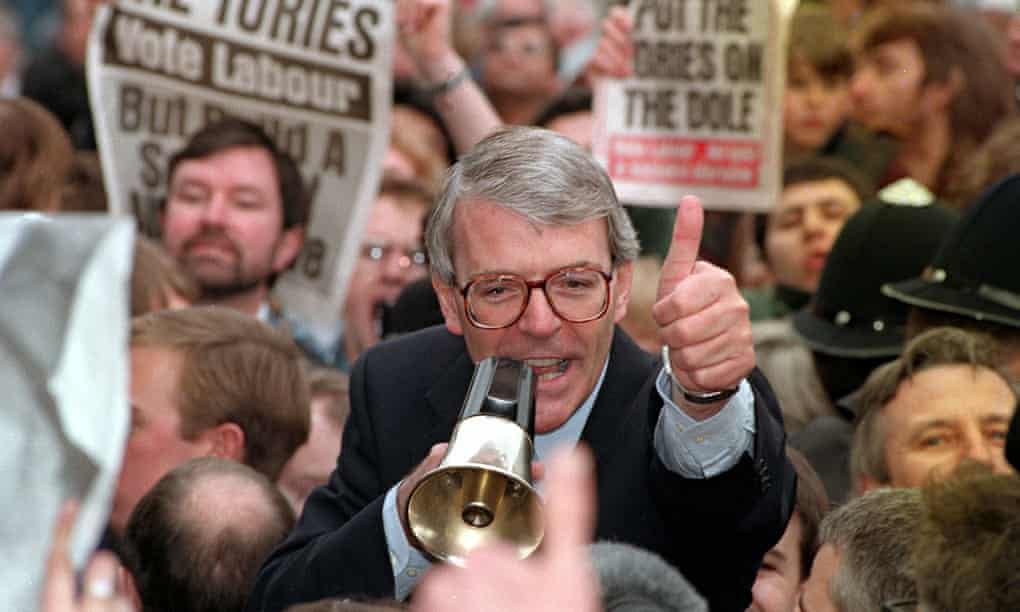
John Major on the campaign trail in 1992, amassing a record vote and high turnout. Should definitely still be Prime Minister...

To clarify, I don't really think that John Major should be brought back as PM (Although I reckon he'd do a decent job of it). But hopefully, it underlines the absurdity of the following claims:

- The number of votes amassed in one election or vote doesn't mean that is a permanent mandate.
- Increasing turnout is desirable, but also doesn't mean that is a permanent mandate.
- Subsequent votes or elections that represent a changed mandate or wish are fine, and indeed normal and natural.

The next time you hear them, point out that John Major should still be Prime Minister. And then explain why. See how that goes down...

Saturday, 28 January 2017

Trump's Muslim Ban- Saving up to 2 lives since 1990

Donald Trump has managed to outrage much of the world yet again this week. He has introduced his much vaunted Muslim ban, which he promised on the campaign trail after a string of terror attacks in Europe and the USA in late 2015.

Of course, banning an entire religion from entry to the United States would have been a blatant breach of the Constitution, so instead the White House has announced that all nationals from 'terror-prone' countries will be denied entry for a certain period. The new 'Axis of Evil' is made up of:

Syria
Iran
Iraq
Sudan
Libya
Yemen
Somalia

Which got me wondering. How many people would still be alive today if previous US presidents had introduced such a measure?

I decided to start in 1990, purely because it was the year I was born. I will admit, I did use the Wikipedia list of terror attacks in the USA. However, like the good historian I try to be, I did check the footnotes. It appears to check out reasonably well.

There is no common definition of what constitutes a terror attack, so doubtless there are some incidents on the list that don't deserve to be there, and some missing that really should be included.

But, using what data I had, I discovered that:
  • There have been 71 terrorist incidents in the United States since January 1990.
  • They resulted in 3372 deaths (with 2996 of those deaths on September 11th 2001).
  • Muslims carried out 24 of those attacks, killing 3118 people. Take 9/11 out of the picture (and I'll explain why below), that becomes 122 deaths.
  • Muslims from the countries covered by the Trump ban carried out between 1 attack (on the strictest possible interpretation of the ban) to 3 attacks (broadest possible interpretation). These attacks killed 2 people under the broad definition, and 1 under the strict one (that being the attacker).
  • The American far-right (which I have taken to include ultra-libertarians, Christian extremists and violent anti-abortion activists) committed 27 attacks and killed 227 people (168 of them being in the 1995 Oklahoma City bombing).
  • The remaining 20 incidents, which killed 30 people, were carried out by people whose motives were unknown, who have never been caught, or who don't really fit into any other category (the Earth Liberation Front featured heavily, as did the Unabomber).
Trump's Muslim ban would not have stopped many terror attacks that made headlines around the world:
  • The person responsible for the 1993 CIA shooting was from Pakistan.
  • The World Trade Centre bombers of 1993 were from Egypt, Pakistan, Kuwait, Jordan and the USA.
  • The US Army officer who carried out the 2009 Fort Hood shootings in Texas was from West Virginia.
  • The Boston Marathon bombers were from Chechnya, which is in Russia.
  • The three men who attacked an art gallery in May 2015, claiming to be ISIS inspired, were all from the USA.
  • The San Bernardino attackers were from the USA and Pakistan.
Most importantly of all, Trump's executive order names the events of 9/11 as the rationale behind his executive order. The 9/11 hijackers came from Egypt, Lebanon, the United Arab Emirates, and the largest contingent came from Saudi Arabia. The masterminds behind the plot had met in Hamburg, in Germany, and travelled to Afghanistan to plan and prepare their attack. Had Trump's Muslim ban been in place in 2001, it would not have stopped a group of Middle Eastern students coming from Germany. The destruction of the World Trade Centre would still have gone ahead.

This all begs the question. What on Earth is Trump up to? He is inflaming world opinion against the United States, in a manner that makes George W Bush look like Mother Teresa. He is breaking a fundamental norm of liberal democracy, indeed one that is enshrined in the US constitution- that there is freedom of religion.

Instead, this is policy as determined by cable news and conspiracy theorists. Islam is the enemy, in the mind of Fox News, Alex Jones, and Donald Trump. So better ban it, quick. Even if it turns out what you're doing is totally illogical and nonsensical.
___________________________
My reluctance to include 9/11 in these statistics is because it was clearly such a one-off event, the mother of all 'spectaculars,' as Al-Quaeda used to refer to them. Yes, it was awful, painful, ugly, and has shaped the world since in ways we still do not really understand. But it is also incredibly atypical, an event that was more akin to an act of war than a terrorist attack. However, as it did happen, and there is no getting around that, I have included it, but also provided the non-9/11 figures for a slightly more nuanced comparison.