Wednesday, 31 August 2016

The X-Files: Series 1, First Half

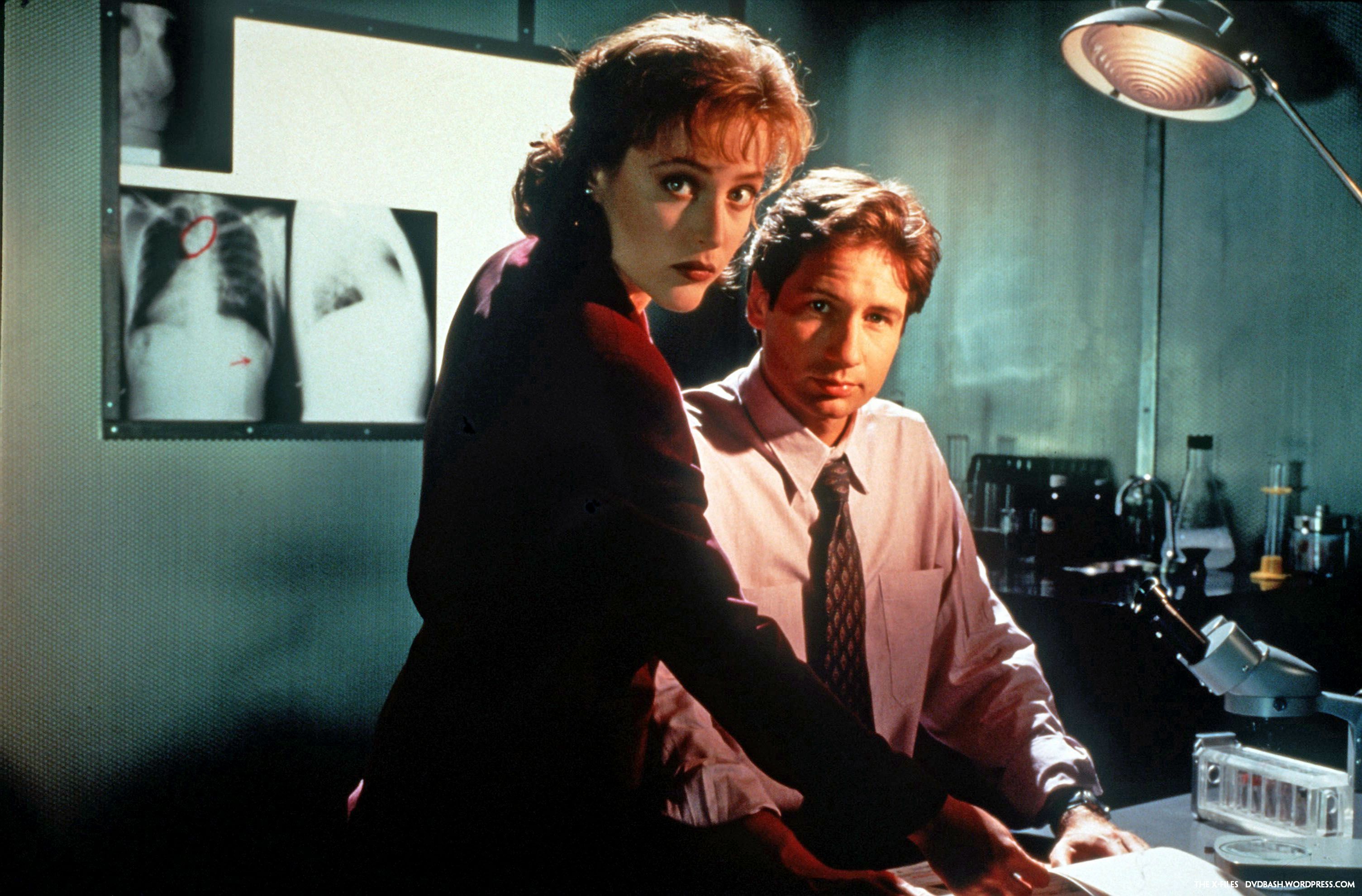
One of the advantages of being a teacher is that you do have a fair amount of time in the summer. One of the things I've done (along with walk a 100km long distance trail, visit Ireland, read a lot, and belatedly do some work) is begun watching the X-Files.

I actually remember watching the pilot episode. I can only have been five or six; BBC Two must have been repeating it. I distinctly remember watching Mulder standing in the pouring rain, pointing excitedly at a patch of road where he had felt time skip. I also remember hiding behind a pillow, despite my Dad assuring me it wasn't scary. I can only presume he chased me to bed before the end of the episode then. I also saw the 2008 film I Want to Believe. I can honestly say I remember *nothing* about it. There may have been snow in it, but beyond that, I have no idea.

I've heard only good things, so I borrowed the first series off my brother on DVD. Halfway through sending him the 19th text about it, I decided to put down my musings. Here are the results.

Pilot
  • Why on Earth did they visit that crime scene at night?!
  • I am never going to Oregon.
  • Was the warehouse from Raiders of the Lost Ark full by 1993?

Deep Throat
  • The 90s called, they want their credit sequence back.
  • The entire Western USA must be entirely full of hippies, cultists, millenarians, and aliens...

Squeeze
  • WHAT IN GOD'S NAME IS IN THAT SEWER??
  • What would happen if Mr Fantastic was a force for evil.
  • WHAT HAPPENED TO HIM?!

Conduit
  • Nice picture of Bill Clinton on the walls of the FBI offices.
  • Seriously, why visit the creepy woods *AT NIGHT*?!?
  • Add hell's angels to the people that are running amock in rural USA.

Jersey Devil
  • Add New Jersey to the list of places to *NEVER* visit...
  • Is there any police department that Mulder hasn't wound up yet?
  • The sheer awkwardness when Scully told Mulder she has a date only confirms she has made the wrong choice...
  • Scully has a pager...

Shadows 
  • Whoever these people are, they clearly don't know Mulder very well to think they can drag him in in the small hours, shown him a corpse with a mysterious cause of death, and not expect him to go chasing after this...
  • Someone has nicked the incidental music from The Fugitive.
  • A sinister Matilda.
  • Scully never seems to see the spooky sinister stuff. How convenient...

Ghost in the Machine
  • A computers story from 1993. What can possibly go wrong? (N.B. There was a dialling tone at one stage, and a floppy disk. And that's without mentioning Mulder's laptop...).
  • The Will Smith I, Robot film, but done properly.
  • Steve Jobs could easily have sued for libel...
  • I'd love to meet a techno-anarchist...
  • The smart home, two decades before it became a reality.

Ice
  • A cold Blair Witch Project opening. 
  • Icy Cape, was Sinister Snows taken? 
  • That bloke from 24 and Apollo 13, he gets everywhere!
  • Scully looks like a cold Princess Leia. 
  • For once, I'm with Scully; incinerate that Godforsaken thing... 
  • Nice Walkman. 
  • Oh yeah, throw the bullets in the snow... 
  • I don't think I breathed through most of that, it was that good. 

Space
  • Nice bit of 70s throwback at the start.
  • The Martian face always creeped me out, glad it isn't just me.
  • This episode is my childhood in a nutshell. 90s NASA, the shuttle and space probes! 
  • Mulder is me, great big giddy kid with the space programme. 
  • The line "I need access to your records!" has never been uttered during a space emergency before or since 
  • Unlike Apollo 13, I didn't know the ending; again, very little breathing... 

Fallen Angel
  • Great, now Wisconsin is on the list... 
  • Wow, that NORAD bloke was sinister... 
  • This is high end government conspiracy stuff- Evolution meets Predator
  • You know it's good when Scully's first appearance is getting Mulder out of a cell... 
  • Like Alan Partridge, Mulder has a Number 1 fan... 
  • Gillian Anderson should have got an Emmy for the look on her face when she found out that Mulder writes into UFO magazines under a poor pseudonym. 
  • Oh dear, maybe Mr Helpful isn't as helpful as he appears... 

Eve
  • Well that's a terrifying start... 
  • Scully's mobile is excellent, I had a friend who had a tribute one... 
  • I love they have to explain what IVF is... 
  • Who *IS* Mr Helpful?! 
  • Excellent, more high end conspiracy stuff.
  • This is even more impressive when you think it was four years before Dolly the Sheep. 
  • First gunshot discharged? I like the lack of reliance on firearms. 
  • Oh good grief, super-intelligent child murderer clones- not the best thing to watch before going back to school... 

Fire
  • Oh good, 90s rural England, as imagined by Americans. 
  • Yeah, Scully gave Mulder's ex the look she deserves. 
  • Mulder had to spell out what the IRA was. 
  • The FBI's arson expert needs to get out more. 
  • Hang on, did they just show the answer a mere 15mins in?! 
  • Oh good, at least there's some character development.
  • Mulder, you're much better off with Scully, rather than this lunatic... 
  • I have never seen anyone look less comfortable in a tuxedo than Mulder. 
  • See, who sits with you when you're ill?!

Overall Observations

This is very much a series of its time. The culture of distrusting the government, and its expression in out of the way places in the rural United States, comes through very clearly. It isn't a huge jump to believe 'weird goings on in Nowheresville, Idaho' when the memories of Watergate, Iran-Contra, Ruby Ridge and the Waco Siege were still fresh in the national psyche.

By my rough count, it took until episode 11 for anyone to shoot at them. Modern American dramas involving law enforcement officers often don't last 11 minutes without a character discharging their weapons. I like it this way, makes it less of a shoot 'em up and more about the quality of the storylines.

It has stood the test of time remarkably well. 1993 is now a very long time ago, and yet you don't seem to notice the technological gulf which separates us from them. The clothing may be hilarious (Mulder appears to have raided M&S' '90s Man' range), the technology may be laughable, but yet you see straight through it.

Scully's facial expressions should have won Gillian Anderson an award. The relationship between the two of them makes for compelling viewing. And dear God it was scary in places. There were episodes I didn't breathe, or hid behind the sofa.

Overall, a very impressive start. I am definitely hooked. As Mulder's office wall declares, I Want to Believe.
Tuesday, 30 August 2016

Syria: The Benefit of Hindsight?

Three years ago today, I posted this beautiful quotation from Robin Cook to this blog.

It was extremely fitting. The British Parliament had voted down David Cameron's plans to launch airstrikes against President Bashar al-Assad's regime in Syria. In the days before the vote, the world had been inching closer to war. Presidents and prime ministers in the West were preparing to lead their airman towards the sounds of gunfire. The two year old Syrian conflict was about to get a lot messier.

All of that came crashing to a halt when British MPs went against the pleading of their own Prime Minister. Their decision to prevent British involvement brought the entire march to war to a shuddering halt, as leaders fell over themselves to check with their own legislatures, or paused to gauge support. It wasn't there. And so the crisis passed, and nothing happened.

At the time, I was jubilant. The elected representatives of the British people, by putting a check on the actions of their own prime minister, had helped to prevent another war between the West and a Middle Eastern dictator. MPs had made up for the catastrophic error of judgement they had made a decade earlier, and restored some moral authority to the Mother of Parliaments.

Three years on, I am not so sure. The decision to spare the Syrian government may have been the worst foreign policy decision we have made about Syria.

Earlier in August, reports began to emerge from Syria of a fresh horror. A suburb of Damascus had been attacked from the air. It wasn't long before hospitals were crowded with people who had clearly been poisoned. Chemical warfare had returned.

There had already been accusations that chemical weapons had been used in the Syrian conflict. But this was evident. One of the clear lines of international relations, that states that use weapons of mass destruction must be held accountable, had been crossed. The War Crimes Tribunals from Yugoslavia had ruled the use of chemical weapons was one of the highest breaches of international law. Britain and America had attacked and destroyed Iraq over the merest hint of a chemical weapons programme. Would Syria be allowed to get away with this appalling slaughter?

The short answer was yes. Although Russia and the USA negotiated a deal to remove and destroy the weapons, the message was clear. The international community did not care enough about the use of chemical weapons to punish Bashar al-Assad and his government. Assad saw that the rest of the world was divided, and so continued his savage fight for survival, safe in the knowledge that not even using poisons against his own people was enough to bring down the wrath of the international community. He has used them again. As have the rebels. The Western world had apparently decided that the use of chemical weapons was not so bad it demanded punishment. That is a staggering message to have sent the rest of the world, to every state considering using these vile weapons in a future conflict. We essentially declared that this wasn't a big deal, providing they tried to make amends afterwards.

And what did the Syrian rebels make of this U-turn by the rest of the world? They had hoped that the rest of the world would be shocked into action by Assad's barbarity. Instead, the world had shown them that it did not care how many Syrian civilians died, or in what manner they died. Instead, many Syrian rebels turned to the groups that promised to take the fight to Assad, no matter what. During late 2013, a group that had existed in the shadows since the suppression of the Iraqi Insurgency announced it was taking control of several Syrian Islamist rebel groups. In honour of this new venture, it called itself the Islamic State of Iraq and Syria.

I'm not saying had we unleashed cruise missiles against Assad's chemical weapons plants that ISIS would never have come into being. But the message it pushed was that jihad would provide the path to ousting Assad. Given the timidity of the rest of the world, you can understand why many Syrian rebels chose ISIS.

When David Cameron took his proposed airstrikes to the House of Commons in August 2013, the example cited was the Iraq War of 2003. That is not right. Iraq was an illegal war, which destroyed the Iraqi state on false pretexts and inflicted misery on millions. That is not what MPs were being asked to endorse. Were it, they should have shot it down in an instant.

No, the better template seems to me to be the end of the Yugoslav Wars in 1995. There, the genocide of Srebrenica hammered home the reality of the conflict. There was outrage, and the UN asked NATO to respond. Under the hammer blows of NATO airstrikes, the Serbs were forced to the conference table. Within a few months, the Dayton Accords had imposed peace on the region, a peace which has now lasted two decades.

I'm not saying we should be trigger happy, or that bombing Syria would not have been difficult, and led to bloodshed, and possibly have made things worse. I have not suddenly become a Chicago-esque, liberal interventionist.

All I'm saying is, three years on, I am not so sure we made the right call.

Friday, 19 August 2016

Lessons from 1991- The Soviet Coup

In the summer of 1991, the world's second strongest country was in turmoil. The USSR was enveloped in a series of crises. The economy was in freefall, with major shortages of goods leading to hours of queuing for even the basic essentials. Nationalists were gaining momentum across the country, threatening to tear the multi-ethnic Soviet Union apart. In January 1991, the Soviet Army had killed 14 people in Lithuania during independence demonstrations. The newly elected Russian president was trying to make Soviet law unenforceable in Russia. Although in March the Soviet people had endorsed a new, looser, federation in a referendum, there was real uncertainty over what came next.

For many hardliners in the Communist Party of the Soviet Union (CPSU), they knew who was to blame for this crisis. Mikhail Gorbachev. Since coming to power in 1985, the Soviet leader had pursued policies called perestroika and glasnost. These aimed to reduce the role of the state in the economy, and make the USSR less repressive and more democratic. The results, seen by the hardliners, had been the collapse of the USSR's communist alliance in Eastern Europe. Now their own country was coming apart at the seams.

So, on August 19th 1991, the coup began. Gorbachev was at his summer retreat in Crimea. He was due to return to Moscow to sign the treaty which would loosen the bonds between the republics of the USSR. The hardliners had to act now. Tanks and soldiers rolled into Moscow. All independent newspapers, TV channels and radio stations were suddenly taken off the air. Gorbachev was placed under house arrest. A state of emergency was declared across the USSR, and the 'Gang of Eight' assumed power. The Soviet Vice-President told the world that Gorbachev was ill, and so he was assuming power.

What they had not reckoned on was Boris Yeltsin. During the 1980s, Yeltsin had been the CPSU boss in Moscow, appointed by Gorbachev. A populist reformer, he had become popular with Muscovites for not tolerating the rampant corruption in the political system. He was appointed to the Politburo, the highest platform of state power. Yeltsin was clearly going somewhere.

And then in 1987 it all changed. Yeltsin became the the first person in history to voluntarily resign from the Politburo, blasting Gorbachev in his final meeting for the slow pace of reforms. From then on, he was a thorn in Gorbachev's side. As the USSR began to open up it's elections, Yeltsin constantly won positions, racking up enormous majorities, until in June 1991 he was elected President of Russia, with 59% of the vote. As he was fond of pointing out, that was more people than had ever voted for the Soviet President, Mikhail Gorbachev.

The coup plotters had not taken the opportunity to delay Yeltsin in Kazakhstan, where he was until two days before their coup. Neither did they arrest him in Moscow. Instead, Yeltsin headed straight for the Russian parliament, which was besieged by the army. There, he mounted a tank, and addressed his supporters. He denounced the coup, and called for a general strike, as well as for Gorbachev to address the people on TV. Thousands flocked onto the streets, surrounding the Russian parliament. In Leningrad and other cities, wildcat strikes began.

The plotters spent the next day preparing to attack the parliament buildings. When it became obvious that they would not succeed without appalling bloodshed, they withdrew the army from Moscow on the morning of August 21st. Gorbachev was able to restore communications and denounce the coup.

Why is this significant? Two reasons. Had the coup not collapsed quickly, there was a real chance of political conflict inside the Soviet Union. In 1991, no nuclear weapons state had ever seen a coup d'etat. An already fractious situation had been made even worse by lobbing an armed takeover into the mix. Coupled with the fact that, despite cuts to the arsenal, the Soviet Union had enough nuclear weapons to destroy the planet several times over, this was a scary moment. The situation could have been extremely bloody, and no one knows how it would have panned out. As it was, the nightmare scenario was avoided.

The other significance is that this was the death knell for the USSR. Had the delegates from the republics met in Moscow on August 20th and signed the New Union Treaty, as they were due to, it is entirely possible that the USSR may have scraped through in some form or another. Instead, this showed that the power rested with the republics, not the Union. Estonia and Latvia used the crisis to declare themselves independent. During the autumn of 1991, this disintegration accelerated, until on Christmas Day 1991, Gorbachev appeared on TV to inform the world that the Soviet Union was over. On Boxing Day, it passed out of history. Not, as many had predicted and feared, in the fires of a nuclear exchange, but because it was what the people wanted.

Russia's post-Soviet experience has not been a happy one. The enormous economic shock of switching suddenly from a command economy to a free market one caused misery through the 1990s. The war in Chechnya was brutal. It is easy to see why Yeltsin was elbowed out in favour of Putin. The post-Soviet world has also been challenging for the republics. Many have languished economically, or switched one dictatorship for the next. And the crisis in Ukraine and Crimea is a reminder that the problems of the USSR are still with us today. There is a certain nostalgia for the USSR in the successor states, as a time when things were better.

But the August coup, and its defeat, shows that the nostalgics are wrong. The Soviet people wanted the USSR to end. This attempt to reimpose it was defeated, not by bloodshed, but by people standing up for what they wanted. And that is what we deserve to remember.

Boris Yeltsin mounts a tank outside the Russian parliament, 19th August 1991


P.S. The Washington Post and New York Times put the consequences, and contemporary relevance, of it all much better than I ever could:

Tuesday, 9 August 2016

The Wit and Wisdom of... John Golding

I would show Foot the opinion polls, and he would say:

'You're wrong! There were a thousand people at my meeting last night, and they all cheered.'

And I'd say:

'Yeah, but there were 122,000 outside saying you're crackers.

John Golding, Labour MP and member of the NEC, on the Labour election campaign of 1983, speaking in 1995 on BBC 2 documentary Labour in the Wilderness

Thursday, 28 July 2016

The Wit and Wisdom of... Joe Ashton

Here's unemployment going up and up and up, here's Mrs Thatcher increasing the rents, increasing the prescription charges, cutting the money to local councils, cutting student grants, doing horrendous things to the National Health Service...

And here's the Labour party, for six months, obsessed with who is going to be deputy leader.

People were looking at us and saying 'this lot aren't fit to run the country.'

Joe Ashton, Labour MP, on the deputy leadership battle between Denis Healey and Tony Benn in 1981, speaking in 1995 on BBC 2 documentary Labour in the Wilderness

Monday, 25 July 2016

Sorry Jeremy, You're Doing The Whole Job Wrong...

When a political party is in crisis, it is often asked 'what is the point of this party?,' or 'what does this party stand for?'

I've heard this a lot in the last few weeks about the Labour party. Riven with internal dissent, and buffeted by external events, Labour is in serious trouble. It's a fair question.

It also has a remarkably simple answer. Because Labour writes all these things down. The Labour Party Rule Book is the place to look, and it clearly says that Labour's purpose:

shall be to organise and maintain in Parliament and in the country a political Labour party.

The Party shall bring together members and supporters who share its values to develop policies, make communities stronger through collective action and support, and promote the election of Labour Party representatives at all levels of the democratic process.  

Note what comes first in that statement. In 1900, the nascent Labour Representation Committee was faced with a choice: were the interests of working people best advanced by operating within or without the parliamentary system? The LRC chose within: the ballot box over the banner, elections over revolutions.

This should be understood by all those who claim to have Labour's best interests at heart. The road to improving the lives of "those who can't speak up for themselves," as John Smith once said, lies in the maintenance of the Labour party in Parliament and in local government. Anything that threatens to neuter that political force is an obstacle on the road to progress.

What is more, this also matters to anyone who wants to see a left-wing government in the UK. Labour is in a unique position in British politics. It is the only left of centre political entity currently capable of assuming national power. When it fails to assume office, the cause and interests of the left are not advanced. When it does win elections, and takes power, the interests of the left are advanced, however slowly and imperfectly. This gives a heavy burden to the Labour party. Without it, there is no dawn for the left, at least not for many years to come. Therefore, it has to strive for office, be it local, regional and national, at every opportunity. The lives of millions depend on it.

At present, Labour is in crisis because of the leader. Jeremy Corbyn was only elected last year, but already many have grave doubts. His MPs have passed an overwhelming motion of no-confidence in him, the NEC has fallen out with him, there is even talk of legal action within the party. Ugly accusations of intimidation, rape, racism, Anti-Semitism and death threats swirl around. There is talk of de-selecting those MPs who do not follow the line laid down by the leadership. All in all, it is an atmosphere of crisis and chaos.

There are a myriad of explanations of the origins and aims of the Corbyn phenomenon. I don't intend to go into them here, as I'm not entirely sure what I think about all of these ideas.

But what I do know is that Corbyn has failed to fulfill his responsibilities as the leader of the Labour Party. The Labour Party Rule Book says that:

The Leader shall, as a member of the NEC, uphold and enforce the constitution, rules and standing orders of the Party and ensure the maintenance and development of an effective political Labour Party in parliament and in the country.  

In the year since Corbyn became leader, Labour has effectively ceased to operate as the Official Opposition. They are trailing the Tories in the opinion polls. Sluggish local election results show that the party is not heading back to power any time soon. The party is riven with internal dissent, much of which has been expressed in abhorrent language and attitudes. There is no way that what is going on can be described as "the maintenance and development of an effective political Labour Party in parliament and in the country."

Under these circumstances, the survival of Labour as a parliamentary force is in grave doubt. The current party leadership has to assume its share of the blame for this appalling state of affairs.

The strange thing is, Labour is reasonably united on policy. Corbyn has introduced no radical departures from the platform on which Ed Miliband stood last May. For all the cries of 'Blairite' to try and smear Corbyn's opponents, there are not many die-hard Blairites left, and certainly not much of his policy agenda remains. If there is an election in the autumn of spring, the shape of the manifesto isn't hard to guess. Whoever the leader was, they would be espousing many of the same ideas.

So it is not on policy grounds that I believe that Jeremy Corbyn should go. The job of the Labour leader is to lead Labour to a parliamentary victory, so it can use the powers of the state to advance the interests of the left, in helping those people who need it the most. Corbyn has shown himself unwilling or unable to do this via the ballot box.  For the sake of everyone who believes in left wing ideas, Labour needs to find someone who is willing and able.


P.S. After I had written this, Corbyn declared over the weekend that he sees himself as the leader of a social movement. I actually think he'd be really good at that. If he has indeed chosen to pursue that path, that is fine. But it is not compatible with being the leader of a political party where the job description commits you to fighting and winning Parliamentary elections. The choice before Labour is even starker than ever.

Wednesday, 13 July 2016

David Cameron's Political Weathering

I was at a BBQ when David Cameron became Prime Minister. I was a student, in the second year of a history degree. The bbq was proving hard to light, as the weather was a bit dodgy. So I missed Brown going. I missed the moment he realises the game was up, and stunned the political world by cwlling it a day. I missed the scramble to get David Cameron to Buckingham Palace in time to prevent a long gap between leaders.

But I was home in time to watch him arrive in Downing Street. What struck me was the choreography of it all. The Labour years had begun in the blazing sunshine of May 1997. Now it was ending in the late spring twilight of May 2010. Rather than the certainty of a booming economy and colossal landslide, Cameron was taking office amid an economic crisis, against the backdrop of a hung parliament. It seemed a perfct metaphor for the trajectory of Labour's time in office. Brave New Dawn to confusing sunset.

I suppose I should thank Cameron. He has been a part of my politicisation. I first became fairly interested in politics just before he ran to be Tory leader in 2005. He was Leader of the Opposition through my later teenage years, when I was struggling to decide what on Earth I believed in. And he was Prime Minister as my views crystallised and hardened, as I saw the country he was trying to create, and decided on the whole that it was not the one I wanted to live in. 

And now he is gone. Sunk by a referendum he did not want, he has been ejected from office barely a year after winning a majority in the Commons. Just as he got the hang of governing, he has had to give it all away.

Today it was cloudy on my way home. Cloudy with some short, sharp showers. So as David Cameron resigns and heads into the sunset, I think that's a reasonably good metaphor for his term as Prime Minister. 

He became Prime Minister in the gloom of the Great Recession, and leaves office with the storm of the EU referendum aftermath on the horizon.