Friday, 31 May 2019

"Dancing on a Volcano"- Britain and the Weimar Republic

There is a historical parallel abroad in the land. It is not nice, it is not pretty. And it hopefully isn't true.

More and more, Britain in the late 2010s is looking like the Weimar Republic. This is the name historians have given to Germany for a decade and a half in the early 20th century. It began in 1918, as the Kaiser was toppled from power and a nascent democracy ended the 'war to end all wars.' It ended in 1933, as economic collapse and political chaos culminated in a takeover by the very epitome of historical evil.

With its narrative of political and economic turmoil, culminating in a serious crisis, the attractions for using Weimar as a parallel to Britain today are obvious. Firstly, there are the huge economic shocks that overwhelmed the political systems. In 2008, there was the Great Recession. Coming off of years of growth and easy money, the implosion of the world financial system was a huge shock. It was followed by the years of austerity, as conservative-minded governments and central bankers used the excuse of the ballooning deficits they'd created to deal with the problem to shrink the size of the state. In the Weimar Republic, the good years of the Golden 20s suddenly gave way to the Great Depression. The collapse of the US stock market had serious ramifications across the world, as US loans were recalled. Germany had been loaned $800 million by the USA to help it with reparations (more of which below), and now couldn't repay. Unemployment skyrocketed to 6 million. Thousands of German companies went under. The Weimar system was totally unable to cope with the catastrophe facing it, and so people turned to those who said they had the answer. Voting for the Nazis was, for many Germans, about choosing a better future, one with money in their pockets and hope for their lives. Sound familiar to 21st century Britons?

The Weimar Republic had been born in defeat. Within a year, the newly installed democratic politicians had agreed to the Armistice, ending the fighting on the Allies' terms, and signed the humiliation that was the Treaty of Versailles. The army was shrunk, land was taken, Germany took the blame for the entire war. Within four years of signing Versailles, the difficulty of paying the crippling reparations had caused a French invasion and hyperinflation.

'The November Criminals' was the insult hurled at those who had allowed Germany to sink into this abyss. The politicians had betrayed Germany, and the German people. They'd allowed the country to be dominated by foreign powers. What was needed was for the German people to re-assert their own national sovereignty. to send a message to the politicians who had got them into this mess, to take back control

I'm being facetious, but only just.

This message of betrayal, this toxic atmosphere led to political violence. There were four serious uprisings by the far-left and far-right. Politicians were assassinated. You might think this doesn't sound like Britain. Think of the heightened rhetoric, the bile and invective hurled at political opponents on both sides of every debate. Think of Jo Cox, gunned down by a far-right obsessive in her own constituency, who stunned the judge into silence when he gave his name in court as "death to traitors, freedom for Britain."

Those who spread this message of betrayal, today we could call them populists. For the first few years, the 'Weimar coalition' of centre-left and centre-right had governed. The SPD, the centre-left party that was cousin to the British Labour Party, was assured of the votes of the workers. The Centre party did exactly what it said on the tin. The conservative right was more complicated, but still present in the Weimar coalition.

Then the Great Depression came. The centre could not hold. Voters flocked left and right. On the left, they found the German Communist Party. Karl Marx had predicted that Germany had the ideal conditions for a communist revolution. In 1917, the world had seen the first successful communist revolution in Russia. Many felt, and feared, that Germany would be next. And on the right, they found the Nazi party. Before it became the definition of evil in the 20th century, the Nazi party was looked to as the hope of Germany. It promised that all of Germany's problems could be easily fixed, all it required was to smash the establishment, put Germany and the Germans first, and trust in them and them alone. Britain of 2019, take note. Nothing is easy. Especially complicated things. Those saying they are easy probably deserve a closer look.

But there are two major differences that separate the UK of 2019 from the Weimar Republic. The Great Depression had a far, far more severe impact on Germany than the Great Recession had on the UK. Yes, the austerity imposed to 'deal' with the deficit has been awful for millions. But the reason that the governments of 2008 decided to run up those deficits was precisely because they wanted to avoid the mass unemployment of the 1930s. The sheer number of people out of work caused the social welfare network to seize up under pressure; a collapse in the tax intake had rendered the system unworkable. Across the world, government policies made things worse, not better. And they got much worse much, much faster than they did in 2008. The depth and severity of the crisis that overwhelmed the Weimar Republic makes even the crash of 2008 look like peanuts.

The even bigger difference between contemporary Britain and the Weimar Republic is that of the democratic tradition. Imperial Germany had had elections, but they had been for a tiny proportion of the population, to a toothless Reichstag. In the UK, we've had 90 years of true universal suffrage, a century of near-universal suffrage, and pretty much two centuries of an expanding franchise. The fact that democracy was so new, so untested in Germany, meant that it would have been a hard road even if there had been no external shocks to the system. Many Germans, particularly on the conservative wing, in the armed forces and in business, saw democracy as an aberration. Nothing encapsulates this better than when Field Marshal Hindenburg was elected as President of the Weimar Republic in 1925; he only took office after he had consulted with the abdicated Kaiser, and had received his blessing. There was always a solid bloc of voters who opted for parties who outright opposed the new system. By the final free and fair election in the Weimar era, in late 1932, around 58% of the vote went to parties committed to ending the Republic. Weimar was memorably described as 'a democracy without democrats.'

When the Nazis assumed power in Weimar Germany, it was initially done quite legitimately. Hitler was invited into office by the President, and the Reichstag was dissolved so he could seek a new mandate from the people. By a piece of astonishing good fortune (for the Nazis anyway), a mentally ill communist burnt down the Reichstag, justifying emergency powers for the government. Soon after the partially-free elections, the Nazis rammed the Enabling Act through the Reichstag by various dubious means. These two measures were the basis for the twelve years of horror that followed. But many Germans were not sorry to see democracy go. It had brought them much trouble and chaos. Dictatorship was a return to what they knew.

The UK of 2019 is indeed severely divided, between political parties that seem unable to bridge their differences. And yes, democracy is having a crisis. But there are two centuries of democratic tradition behind it in the UK, and a century of true mass democracy, both for parliament, but also for local councils, regional and national assemblies, and yes, referendums. By itself, this will not be enough to save our democratic tradition. But it hopefully means it will not go down without a fight.

What happened in the Weimar Republic isn't inevitable. It doesn't have to happen here.

A protest against Brexit, 2019, and against the Treaty of Versailles, 1919

Stabbed in the back by the Weimar politicians and drinking the poison of Brexit betrayal

The passage of the Enabling Act by the Reichstag, March 1933, which ended the Weimar Republic and created a one-party dictatorship in its place

Saturday, 25 May 2019

Do all political lives end in failure?

And so, at long last, she is gone.

No one can be surprised at Theresa May's departure from Downing Street being announced yesterday. After months of presiding over a national disintegration, it was only a matter of time.

At least, this was the tone of much of the media coverage of her departure. Which got me wondering, as, if you think about it, it is only a matter of time before all Prime Ministers leave office. Even Tony Blair and Margaret Thatcher, at the height of their power, flush from their landslide victories, were only temporary occupants of Number 10.

Much has also been made of how May is going at a time which is not of her choosing. Again, this left me thinking, doesn't that happen to all of them? In my lifetime, Margaret Thatcher was defenestrated, John Major was buried beneath a landslide, Tony Blair was hounded from office by his own party, Gordon Brown saved the world but not the election, and then David Cameron decided to save his party with the referendum. And we all know how that went.

This seems a pretty sorry record, even for those on that list deemed to be successful leaders. Enoch Powell once said that "All political lives, unless they are cut off in midstream at a happy juncture, end in failure, because that is the nature of politics and of human affairs."

That definitely appears to be the case recently. But has it always been like that?

So, for all the Prime Ministers since the Second World War, here is when they left office, and why.

(You're welcome)

Theresa May- 2019, failing to deliver the results of the referendum.

David Cameron- 2016, losing the referendum.

Gordon Brown- 2010, election defeat (Well, he was unable to remain as Prime Minister in a hung parliament, but you know what I mean).

Tony Blair- 2007, conflict between Blairites and Brownites inside Labour pushed him out.

Major- 1997, landslide defeat of epic proportions.

Margaret Thatcher- 1990, whole multitude of reasons (poll tax, personality clashes, European integration, voter fatigue, party fatigue, the fact even some Tories thought she was absolutely insane).

James Callaghan- 1979, election defeat.

Harold Wilson- 1976, resigned.

Edward Heath- 1974, election defeat (Again, unable to remain Prime Minister in a hung parliament).

Harold Wilson- 1970, election defeat.

Alec Douglas-Home- 1964, election defeat

Harold Macmillan- 1963, illness (Although in reality Macmillan was looking for a way out after a very turbulent couple of years).

Anthony Eden- 1957, Suez Crisis, plus the fact his health collapsed due to the strains of running the disastrous government that he did.

Winston Churhill- 1955, suffered a stroke in office, and his health, plus advancing age, led him to go into serious decline.

Clement Attlee- 1951, election defeat (in a setup that could only happen in Britain, Attlee polled Labour's highest ever number of votes, more than Churchill, and still somehow ended up losing).

Winston Churchill- 1945, election defeat, despite leading the country to victory in the Second World War.

Amongst the people turfed out over election defeats, hung parliaments, illnesses, and party political intrigues, the end of one premiership stands out. In 1976, Harold Wilson resigned as Prime Minister because he could. 

Both at the time and since, speculation has been rife. Were secret documents stolen from Downing Street in the weeks before, causing Wilson to go? Was his adviser's brother involved in fraud? Was he having an affair with his adviser? Had some shadowy part of MI5, or the South African security service, got something against him? Was he a Soviet spy? Was he ill, either with the colon cancer that would claim his life in 1995, or could he detect the early stages of Alzheimers that blighted his famous memory?

Or was it simply that he had always intended to go on his own terms? By 1976, Wilson had served as Prime Minister for nearly 8 out of the last 12 years, and he was exhausted. Even before his shock defeat in 1970, he had been telling people he didn't intend to serve as Prime Minister longer than 8 years, before he'd hand over to someone else. With his second government facing horrendous difficulties, and Wilson having recently turned 60, maybe it seemed like the time to honour his word and move on. Whatever it was, Wilson stands alone in postwar politics in having left on his own terms.

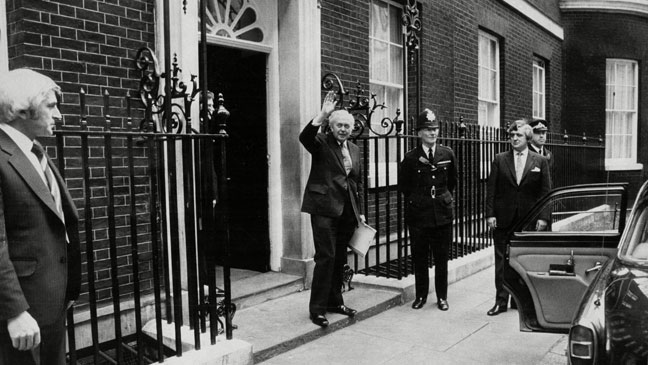
Wilson in 1976, becoming the only British Prime Minister in postwar history to leave Downing Street on his own terms.

As we watch Theresa May prepare to end her disastrous premiership, it is worth reflecting that, for most Prime Ministers, the end is never how they imagine it. Every Prime Minister bar one has been forced out of office at a time not of their choosing, having failed to achieve the goals they wanted. The Tory MPs scrambling to replace May should probably take note.

Thursday, 28 March 2019

The Night the Government Fell

A government without a majority, staggering from day to day in the House of Commons, wheeling and dealing in a desperate bid to survive. A referendum which destroyed the government's chances of staying in power. A minor party from the Celtic fringes of British politics keeping the government awake and fretting at night. A radical opposition leader, beloved by the party membership but widely distrusted by the rest of the front bench.

How things don't change. Forty years ago today, things look very similar to how they do today. Today marks forty years since the last time a UK government was brought down on the floor of the House of Commons in a no confidence motion.

James Callaghan had become Prime Minister in 1976. That was pretty much his last piece of good luck. His majority gone the day he took office, amidst a horrendous economic storm, and the creditors of the IMF circling, it had been a miracle that Callaghan had survived the year without his government falling. In fact, by late 1978, Labour had pulled even with the Conservatives in the opinion polls. Callaghan mulled an early election. In the end, in September 1978, Callaghan went on TV and dropped the bombshell. He would not go to the polls, but would wait until next year.

Callaghan showing the balancing skills that kept him in office against the odds for three long years

Big mistake. At the very same moment, the Ford car workers in Dagenham went on strike for higher pay. The government wanted to restrict pay rises to 5%. The Ford workers got 17%. This triggered a series of walkouts across huge swathes of industry. It was nicknamed the Winter of Discontent.

Britain in the Seventies was no stranger to strikes. The 1971-72 strike by the miners had caused blackouts, and the Three Day Week of 1974 was unprecedented in Britain's postwar history. The Winter of Discontent was far less disruptive than either of those events. But it marked the moment when the Labour government of 1974-79 went into terminal decline.

The Winter of Discontent

If it was the Ford workers in Dagenham that began the collapse of James Callaghan's government, it was voters in Scotland and Wales who delivered the crippling blow. At the depths of unpopularity, in early March 1979, the government was committed to hold devolution referendums about establishing assemblies in Scotland and Wales. The Welsh assembly was roundly rejected; the Scottish Assembly was a more complicated case, as voters did pass it, but not by the required margin. The SNP and Plaid Cymru now had no reason to prop up Callaghan's government, and the SNP made it clear they would vote to bring the government down. The Conservatives, seeing their chance, laid down a motion of no confidence.

But Labour were not going down without a fight. Talks were held with Plaid Cymru, the Welsh nationalists, and the breakaway Scottish Labour Party, who both agreed to support the government. A freedom of information law was offered to Clement Freud to try and peel him off from the rest of the Liberals. Some Ulster Unionists were brought onside by promising them a pipeline to Northern Ireland. This agreement nearly fell apart when the deal was signed in green ink by accident; it had to be quite literally taped back together.

More worrying was the health of Alfred Broughton, a West Yorkshire Labour MP. Broughton was terminally ill, and his doctors warned that to move him from Batley and Morley down to London would kill him. The Labour whip Walter Harrison asked his Tory counterpart, Bernard Weatherill, if they could reach an agreement for an abstention. Weatherill refused, then offered to abstain himself. Harrison said no, thereby saving Weatherill's career, and quite possibly allowing him to become the Commons' Speaker four years later as a result.

The night itself was one of high tension. There are stories of Labour whips prising half-drunk members out of the pubs and bars of Westminster, where they'd been detained by journalists hostile to the government. Searches were conducted of the Palace of Westminster to make sure there were no lost MPs, or to spot opposition MPs being hidden to vote at the last possible second, to confuse the numbers. It was bordering on chaos.

In the chamber of the House of Commons, the atmosphere was electric. Callaghan, knowing the hour of reckoning had come at last, gave a good defence of his government, branding the SNP as Turkey's voting for an early Christmas. Thatcher's speech fell flat, living up to her then nickname of Cautious Margaret. Gerry Fitt, the SDLP member for West Belfast, decried the government's hardline militaristic attitude to Northern Ireland, and said he couldn't go into the lobbies with his socialist allies tonight. Frank Maguire, the elusive Republican MP for Fermanagh and South Tyrone, turned up to 'abstain in person.'

But the real star of the night was Michael Foot. The leftwing firebrand, who had become Callaghan's Leader of the House of Commons, put in the performance of his life. He savaged the uncomfortable bedfellows arranged opposite Labour, pouring scorn on their opponents; he famously described David Steel, the Liberal leader, as having "passed from rising hope to elder statesman without any intervening period whatsoever." In his final paragraphs, Foot launched an impassioned defence of Labour's achievements in office across the 20th century. Were he never to have presided over Labour's sorry performance in 1983, he would have been far more fondly remembered for this.

The hero of the hour

Yet despite all of Foot's rhetorical brilliance, the desperate rushing about of the whips, the timidity of Mrs Thatcher, the result went down to the wire. In a pre-TV era for Parliament, people were forced to rely on radio to discover what was going on. As the tellers lined up to deliver the result, the Tory tellers stood on the losing side. Roy Hattersley, Labour's Prices and Consumer Protection Secretary, watched Thatcher go white, and mouth "I don't believe it."

It wasn't to be believed. In the crush, the tellers had stood in the wrong place. The government had 310 votes, to the opposition's 311. The House of Commons had no confidence in Her Majesty's Government. As the opposition benches erupted in cheers, and the Labour benches were led by backbencher Neil Ninnock in singing 'The Red Flag,' Callaghan got to his feet for the last time as Prime Minster. "Now that the House of Commons has declared itself, we shall take our case country." 

The aftermath of this dramatic night cannot be understated. The election called for May 1979 saw the Conservatives sweep into power. They would remain in office for another 18 years, and transform Britain completely in that time, as monetarist economics and shock therapy would decimate industry and huge swathes of the country. Especially grimly ironic was the fact that these changes hit Scotland the hardest; a cry still levelled against the SNP is that in its opportunism it let in Thatcherism. But the 1980s were not kind on anyone on the left. Labour would come close to destroying itself in the years that followed, in a civil war which makes their current problems look like a picnic in comparison. Many confidently predicted that there would never be another Labour government, and that James Callaghan's last stand on the floor of the House of Commons was the dying gasp of a political movement.

And yet, this was not quite the full picture. Labour may have been defeated in 1979, but it actually added 70,000 votes to its October 1974 share. An increased turnout, and huge shifts from the Liberals and minor parties, put Mrs Thatcher into office, not any collapse of the Labour vote. The Winter of Discontent did not taint Labour, as many claimed. Clearly, Callaghan was doing something right. But this cannot hide the fact that 1979 represented a catastrophic reversal for Labour. The next Labour Prime Minister to rise to the despatch box had only been a member of the party for four years in 1979, and hadn't even started looking for a seat in Parliament. An entire generation would come of age before the Tories were removed from power.

The last old Labour government had gone down fighting in a blaze of glory, having been kept alive on borrowed time and through sheer force of will. But that can't hide how much of a disaster it was, the night the government fell.

If you want to relive the entire night in all its glory, look no further!

https://www.youtube.com/watch?v=ifMiJ7DcUi0 BBC documentary from 2009

https://www.youtube.com/watch?v=ZqzIZVJOQdk BBC coverage from 1979

Sunday, 27 January 2019

Never shall I forget

Never shall I forget that night, the first night in camp, that turned my life into one long night seven times sealed.
Never shall I forget that smoke.
Never shall I forget the small faces of the children whose bodies I saw transformed into smoke under a silent sky.
Never shall I forget those flames that consumed my faith forever.
Never shall I forget the nocturnal silence that deprived me for all eternity of the desire to live.
Never shall I forget those moments that murdered my God and my soul and turned my dreams to ashes.
Never shall I forget those things, even were I condemned to live as long as God Himself.
Never.

From Night by Elie Wiesel, Nobel Peace Laureate who survived both Auschwitz and Buchenwald.


When the Nazis came for the communists,
I remained silent;
I was not a communist.

When they locked up the social democrats,
I remained silent;
I was not a social democrat.

When they came for the trade unionists,
I did not speak out;
I was not a trade unionist.

When they came for the Jews,
I remained silent;
I wasn't a Jew.

When they came for me,
there was no one left to speak out.

First They Came, by Martin Niemöller, German priest, who initially supported the Nazis, but turned against them and was imprisoned in Sachsenhausen and Dachau. For a really interesting history of this poem, have a read of this piece of research.

Red Army soldiers opening the gates of Auschwitz-Birkenau, January 27th 1945

Monday, 31 December 2018

2018 in books

As previously, the list no one has been waiting for...

Target- 25
Books read- 22
Pages read- 10,165 (up from last year, so I've read fewer books, but they've been longer!)
Numbers of new books- 22

Fiction/Non-fiction ratio- 5:17 (another dreadful year for fiction)
Longest Book- Jonathan Strange & Mr Norrell, Susanna Clarke, 1005 pgs.
Shortest Book- The Unknown Unknown: Bookshops and the Delight of Not Getting What You Wanted, Mark Forsyth, 23 pgs.
Quickest Read- The Unknown Unknown: Bookshops and the Delight of Not Getting What You Wanted, Mark Forsyth, August 30th 2018
Longest Read- Jonathan Strange & Mr Norrell, Susanna Clarke, July 4th 2017 - May 15th 2018
Most Read Authors- No repeat reads this year!
Ebooks- No Is Not Enough: Resisting Trump's Shock Politics and Winning the World We Need, Naomi Klein; Killing a King: The Assassination of Yitzhak Rabin and the Remaking of Israel, Dan Ephron; The Invisible Bridge: The Fall of Nixon and the Rise of Reagan, Rick Perlstein.
Audio books- More of a podcast man this year. Maybe they should get a review too...
Useless Fact- I really am surprised at how many books about one historical city Ken Follett has got in him...

The List

Things Can Only Get Worse?: Twenty Confusing Years in the Life of a Labour Supporter, John O'Farrell
The Anglo-Saxons, James Campbell, Eric John, Patrick Wormald
Bitter Freedom: Ireland in a Revolutionary World, 1918-1923, Maurice Walsh
Race of a Lifetime, John Heilemann and Mark Halperin
It Can't Happen Here, Sinclair Lewis
Nothing Venture, Nothing Win, Edmund Hillary
Jonathan Strange & Mr Norrell, Susanna Clarke
The Ghost, Robert Harris
No Is Not Enough: Resisting Trump's Shock Politics and Winning the World We Need, Naomi Klein
A Column of Fire, Ken Follett
Pinochet in Piccadilly: Britain and Chile's Hidden History, Andy Beckett
Moskva, Jack Grimwood
Killing a King: The Assassination of Yitzhak Rabin and the Remaking of Israel, Dan Ephron
Under Another Sky: Journeys in Roman Britain, Charlotte Higgins
On the Map: Why the World Looks the Way it Does, Simon Garfield
Time and Chance, James Callaghan
The Unknown Unknown: Bookshops and the Delight of Not Getting What You Wanted, Mark Forsyth
The Invisible Bridge: The Fall of Nixon and the Rise of Reagan, Rick Perlstein
Iron Curtain: The Crushing of Eastern Europe, 1944-56, Anne Applebaum
The Private Lives of the Saints: Power, Passion and Politics in Anglo-Saxon England, Janina Ramirez
Citizen Clem: A Biography of Attlee, John Bew
The Tigers of the Snow: How One Fateful Climb Made the Sherpas Mountaineering Legends, Jonathan Neale


Friday, 14 December 2018

"Come and go with me to that land": Britain's First Democratic Step

On December 14th, 1918, the country voted. As it did so, it changed, irreversibly. It was the first step on the final stage of change, from the autocratic, imperial power we had been, to the modern representative democracy we are today.

1918 was the first electoral contest in which the property qualification for men was removed, as per the terms of the Representation of the People Act of 1918. Now, all men could vote in the constituency in which they lived, provided they were over 21, or over 19 in the case of those in the armed forces. 5.6 million men were added to the electorate, the largest ever increase. No more would the money or status of the individual voter impact on the act of voting for the government.

More famously, this was the election in which women could vote for the first time.

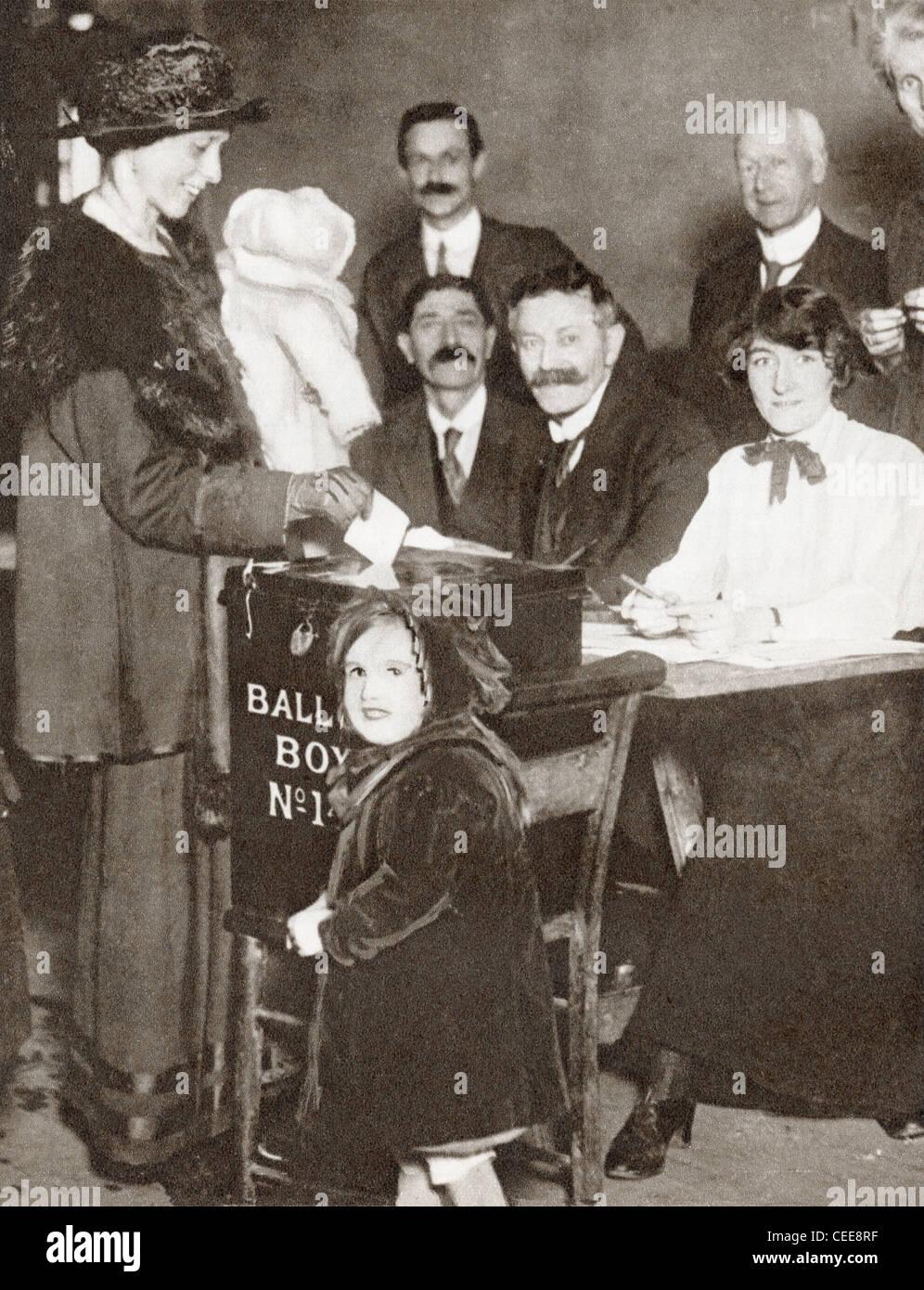
One of Britain's first female voters, casting her vote a century ago today

Well, not exactly. Before the 1832 Great Reform Act, there had been plenty of female electors. From the Middle Ages until 1832, the franchise was determined by your wealth; any rich enough woman would be enrolled. In practise, the only women with sufficient independent wealth were widows. These early participants in the first pangs of electoral democracy are frustratingly hard to spot in the historical record, but they are there, ghostly echoes of a forgotten world. In a by-election in Elizabethan Aylesbury, comments were made about women doing the voting. Complaints were made when women in Norfolk voted for the Long Parliament in the 1640s. These scraps are all we have of what was clearly a much bigger picture.

But the door was firmly slammed shut by the Great Reform Act; it explicitly restricted the franchise to 'male persons.' Even as that electorate widened to encompass more and more men, it remained sealed off to female voters. And yet, local election rolls from the 1840s onwards show that female voting was very much still alive at parish and municipal elections. The government did eventually pass some concessions. Single rate paying women were allowed to vote in local elections in 1869, and from 1894 this was expanded to cover married women. In 1867, an error by a polling clerk enabled elderly Lily Maxwell, a widowed shop owner, to vote in a parliamentary by-election in Manchester, capturing national attention and sparking many of the early suffrage societies.

What is true is that 1918 marks the first time a significant number of women voted in a British election. Yet the recent slaughter had taken its toll on the country. Were the franchise to have been expanded to encompass all women, they would have constituted the majority of the electorate. As a result, the 1918 Representation of the People Act specified that the only women who could vote were to be over 30and owned or rented property worth more than £5, or was married to someone who did, or was a graduate of a university with a constituency. 8.9 million women were added to the franchise; a remarkable start, but still not quite there.

On this day, at the first point of asking, a female candidate was actually elected to the House of Commons, the self-declared mother of parliaments, taking over 60% of the vote in her constituency. Yet the overwhelming victor in the seat of Dublin St Patrick's did not take her parliamentary seat.

Countess Markievicz, the first woman elected to Parliament, campaigning in a by-election in 1917

This wasn't due to a ignoble protest about women voters by men, or a last minute legal challenge, or a push by the suffrage campaigners to get full equal voting rights. Constance Markievicz didn't take her seat in Parliament because she was in Holloway prison, imprisoned for protesting against wartime conscription. Even had she been a free woman, she had not intention of going to Westminster. This is where the third reason this election is so important becomes clear. The 1918 election marks the beginning of the endgame of British rule over Ireland.

At Easter 1916, a ragtag band from the Irish Republican Brotherhood had staged an uprising across Ireland, in an attempt to use Britain's distraction by the First World War to drive them out of Ireland. The Easter Rising failed miserably, with the tiny numbers of rebels overwhelmed by the full military might of the most powerful empire on Earth, their leaders executed or thrown in prison. The self-proclaimed Irish Republic had lasted less than a week.

By 1918, resentment seethed across Ireland. Resentment at the treatment of the Easter rebels, resentment at London's attempts to impose conscription on the island, resentment at the imminent partition of Ireland along religious and political lines. When the election was called, the Irish Labour party agreed to stand down, to give a clear choice to the people of Ireland- vote for Sinn Fein and independence, or the Unionists to stay with Britain.

The results were wide open to interpretation. Of the 105 Irish seats, Sinn Fein took 73 out of the 105 seats. They took 46.9% of the votes across Ireland, but this amounted to 65% of the vote in the areas on the brink of leaving the UK; although in many areas they ran unopposed, and so no votes were cast in those areas. The Unionists took a quarter of the vote; however, this was mainly based on sweeping the seats in what was to become Northern Ireland- outside of this area, they only took one seat, in south Dublin, and the two seats given to the Irish universities. The old Irish Parliamentary Party, which for forty years had been the dominant voice of Ireland at Westminster, was crushed, holding a mere 6 of its 74 seats; however, it did take a fifth of the votes, and this represented more total votes than ever before, thanks to the expansion of the franchise. Quite what was to be made of this mess was anyone's guess.

Tensions were running high across Ireland

It fell to the MPs of Sinn Fein to make the next move. Those able to do so convened at the Mansion House in Dublin, saying they would boycott the Westminster Parliament, as it had no right to rule them. They called their new assembly the Dáil Éireann, and invited all Irish MPs to attend. The Unionists and moderate nationalists would not come. Only 27 of Sinn Fein's new politicians were free men. When the roll call was conducted, the many missing members were described as é ghlas ag Gallaibh, or 'imprisoned by the foreigners.'

Their next move was just as bold. The Dail declared that, rather than having been crushed and buried in 1916, the self-declared independent Irish Republic was very much alive, now with a mandate from the people of Ireland. On the face of it, this was suicide. Every attempt by Ireland to sever the union unilaterally had failed, including one barely two years before. Only one part of the British Empire had ever succeeded in leaving British control by force of arms. And Ireland was nowhere near as powerful as the Thirteen Colonies of British America had been in 1776.

The words of the Dail could have ended up being an empty declaration, lost in the tides of history. But on the same day the Dail announced independence, remnants of the Irish Volunteers attacked a Royal Irish Constabulary wagon bringing explosives to a quarry in County Tipperary. In the shootout, two RIC officers were killed. The Irish Volunteers hadn't aimed to coordinate their actions with the Dail. But the Volunteers now saw themselves as the army of the Irish Republic, and with shots fired they set about attempting to achieve a military victory against Britain by force of arms.

The 1918 election did not yet see Britain become a perfect democracy. Although virtually all adult men could vote, the exclusion of 57% of women, and continued irregularities such as business voting and the university constituencies meant that it wasn't there yet. And the election in Ireland plunged one part of the United Kingdom into a vicious civil war, which had consequences lasting well into the 21st century.

And yet, this was the first election in British history which was something approaching democratic. In the previous elections of 1910, 7.6 million people had been able to vote. In 1918, the total possible number of voters was 21.4 million. And 1918 transformed the political landscape forever. David Lloyd George, the popular wartime leader, split the Liberal Party. His supporters continued in government with the Conservatives. The Liberals who didn't follow him into this unholy alliance were crushed at the polls. But Lloyd George's supporters were only saved by their pact with the Tories. Although they came fourth in terms of seats, the second placed party in terms of the vote share, with a fifth of the voters supporting them, was the Labour Party. As the Liberal star waned, the Labour star waxed. The modern political landscape, recognisable to us today, was being born.

I got a brother in that land

Where I'm bound
Where I'm bound

I got a sister in that land
I got a sister in that land 
I got a sister in that land

Where I'm bound
Where I'm bound

Come and go with me to that land

Sunday, 11 November 2018

To Germany, by Charles Sorley

You are blind like us. Your hurt no man designed,
And no man claimed the conquest of your land.
But gropers both through fields of thought confined
We stumble and we do not understand.
You only saw your future bigly planned,
And we, the tapering paths of our own mind,
And in each other's dearest ways we stand,
And hiss and hate. And the blind fight the blind.

When it is peace, then we may view again
With new-won eyes each other's truer form
And wonder. Grown more loving-kind and warm
We'll grasp firm hands and laugh at the old pain,
When it is peace. But until peace, the storm
The darkness and the thunder and the rain.

To Germany, by Charles Sorley. Killed at the Battle of Loos in 1915, aged 20

Lieutenant Arkwright of the 9th Hussars, washing in the grounds of a chateau, September 5th 1914. During last few days, the British Army had retreated several hundred miles, from Mons in Belgium to the outskirts of Paris. Across 1914, the all-volunteer, pre-war professional British Expeditionary Force suffered 90,000 casualties, which was greater than the number of soldiers originally sent.


Men of the 1st Lancashire Fusiliers, some time before 7am on July 1st 1916, preparing to attack Beaumont Hamel. The Battle of the Somme was when Britain's volunteer armies were first used in large numbers, and 18,000 soldiers were killed on that first day.


Soldiers and civilians in Birmingham, celebrating the announcement of the Armistice, November 11th 1918.