Thursday, 27 October 2022

The Day the World Almost Ended

It was the silence which people noticed. For a year, the people of the coastal village of Sandbank in Scotland had become used to the noise of their new neighbours. But on Saturday 27th October 1962, they awoke to nothing. It was a silence which spoke volumes. It signalled that the end of the world was upon them.

Sandbank sits on Holy Loch, which links directly to the sea. Since 1961, their little village was the closest to a new US Navy base, the European site for their submarine fleet. On that October morning in 1962, all the submarines were missing. They had slipped away in the night, and were at that moment out in the North Atlantic. From deep beneath the waves, their commanders were selecting towns and cities deep inside the Soviet Union. Each would be the target of a Polaris missile, far more powerful than the atomic bombs which had obliterated Hiroshima and Nagasaki seventeen years previously. In those boats, enough destruction existed to kill tens of millions. And they were being prepared for launch.

American nuclear submarines at Holy Loch in Scotland, 1962

In London, the Prime Minister, Harold Macmillan, was making an unprecedented decision. He had summoned his Cabinet to a Sunday meeting, the first since the Second World War. On the agenda was one item. The government would begin to move civil servants and military personnel out of London, into the network of bunkers and tunnels underneath the Cotswold Hills, known as TURNSTILE. This was the first stage of Britain's plans to ensure some government survived the nuclear war that all believed was now virtually inevitable.

Macmillan could also update the Cabinet on his discussions with the American President. He had been speaking daily to John F Kennedy. For it was Kennedy who had, in part, brought the world to the brink of Armageddon. Five days previously, he had revealed to the world that American spy planes had found Soviet nuclear missiles on the island of Cuba, a mere 90 miles from the Flordia coast. Kennedy had already been stung by Cuba; in April 1961, US-sponsored Cubans had tried to invade Cuba to overthrow the new communist government of Fidel Castro. It had been a disaster, and Kennedy had been made to look ridiculous. However, Castro had been spooked by the US-sponsored invasion, and had asked the USSR for help. The USSR could not ignore the only communist country in America's backyard, and so their leader, Nikita Khrushchev, approved the placing of nuclear missiles in Cuba. Now they had been found.

The photo which almost triggered a world war

Kennedy had faced down advisors in his administration and military who wanted to invade Cuba, or bomb the missile launch sites. Instead, he had opted for a blockade, or 'quarantine' of Cuba, to prevent more missiles arriving, and demanded the exisiting missiles were removed. He was clear that any use of the missiles would be considered a direct attack by the Soviet Union on America, and would lead to war between them. He hoped this strong language and a step short of force would be enough. 

Kennedy's speech announcing the discovery of Soviet missiles on Cuba, 22nd October 1962

By Saturday 27th October, it looked as if it had failed. The Soviet missiles were still in Cuba, and were still being prepared for launch. An American U2 spy plane was shot down that morning over Cuba, the pilot killed. Kennedy was running out of options. Castro was asking the USSR to approve the missiles for pre-emptive use against the USA. It seemed as if only an invasion would stop him, but that would mean a third world war. The US communicated to their NATO allies that they needed to be ready to withstand an attack by the Warsaw Pact.

Meanwhile, out at the blockade, US Navy ships were dropping dummy explosives on a Soviet submarine, not realising it had nuclear weapons on board, and that the captain believed the explosives targeting him were real. Another U2 spy plane over Alaska had got lost, and had crossed into Soviet airspace, where it was intercepted by Soviet jet fighters. Not for nothing was this day later called 'Black Saturday' by those working in the White House. The world was teetering on the edge of a nuclear war.

The Soviet submarine B59, eventually forced to the surface by American explosives

It should come as no surprise that the world did not end that Saturday in 1962. Overnight, US diplomats had been busy translating a long letter they had receieved from Khrushchev. In it, he had offered to remove the missiles if America promised never to invade Cuba again. Khrushchev then made a public broadcast, adding the catch that the USA would have to remove their own nuclear missiles from the Turkish border with the USSR. Kennedy replied to Khrushchev's first letter, but ignored the second message in public. It seemed like a long shot.

In Moscow, Khrushchev knew that the situation had spiralled out of control. He had given explicit instructions for force to not be used against American forces, yet that was clearly being disregarded. It would be very easy for the situation to blunder into an exchange of nuclear weapons in which millions would perish. So when Kennedy's offer came in,  Khrushchev took it, without consulting the rest of the Soviet government. It was made easier when the Americans assured the Soviets in private that the American missiles in Turkey would be dismantled as well.

 And so by the skin of our teeth, the world made it through

To the world, it looked as if the USA had outsmarted the USSR. The secrecy of the Turkish missile deal lasted into the 1990s. Kennedy repaired his reputation, which had been badly damaged by his earlier blunders over Cuba. Khrushcehv meanwhile was living on borrowed time. He was deposed in 1964, in part because other Soviet politicans were furious that it looked as if the USSR had backed down. Of course, by that point Kennedy had passed into myth and legend, the victim of an assassin's bullet.

The Cuban Missile Crisis remains the closest the world deliberately came to a nuclear war. Black Saturday, 60 years ago today, was the day the world came closest to ending deliberately. And it was only by a stroke of good fortune that the human race lived to see Sunday 28th October, and all those days since.

Thursday, 30 December 2021

2021 in Books

Somehow, it is that time of year again, where I realise I have read some stuff. 

Books read- 32
Pages read- 11,524
Target- 30

  • Fiction/Non-fiction ratio- 1:31, perhaps the worst year ever for fiction
  • Longest Book- FDR, 858 pages
  • Shortest Book- Marx, 92 pages
  • Quickest Read- Marx, Beyond Wiping Noses and Richard II: A Brittle Glory, all read in a day
  • Longest Read- Technically Seven Steps from Snowdon to Everest, however that was a Kindle read for being in the tent so took three years. Otherwise, it was listening to The Secret Commonwealth, from Dec 2020 until July 2021.
  • Most Read Authors- No repeats again.
  • Ebooks- To Hell and Back: Europe 1914-1949; Stasiland; Four Princes; The Book of Trespass;
    A Great and Terrible King; Beyond the Red Wall; Seven Steps from Snowdon to Everest; Royal Witches; Dead Famous; Bloc Life; Fake History; Germany 1945
  • Audio books- The Secret Commonwealth; Walking Home
  • Useless Fact- How I'm ever going to keep this pace of reading up without lockdowns I don't know...


The List

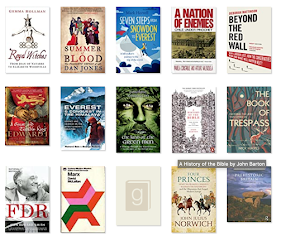
  • To Hell and Back: Europe 1914-1949, Ian Kershaw
  • Stasiland: Stories from Behind the Berlin Wall, Anna Funder
  • Prehistoric Britain, Timothy Darvill 
  • Four Princes: Henry VIII, Francis I, Charles V, Suleiman the Magnificent and the Obsessions that Forged Modern Europe, John Julius Norwich
  • Inside Story: Politics, Intrigue and Treachery from Thatcher to Brexit, Philip Webster
  • Marx, David McLellan
  • FDR, Jean Edward Smith
  • The Book of Trespass, Nick Hayes
  • A History of the Bible: The Book and its Faiths, John Barton
  • The Land of the Green Man: A Journey Through the Supernatural Landscapes of the British Isles, Carolyne Larrington
  • Everest and Conquest in the Himalaya: Science and Courage on the World's Highest Mountain, Richard Sale and George Rodway
  • A Great and Terrible King: Edward I and the Forging of Britain, Marc Morris
  • Beyond the Red Wall: Why Labour lost, how the Conservatives won and what will happen next?, Deborah Mattinson
  • A Nation of Enemies: Chile under Pinochet, Pamela Constable and Arturo Valenzuela
  • Seven Steps from Snowdon to Everest: A hillwalker's journey to the top of the world, Mark Horrell
  • Summer of Blood: The Peasant's Revolt of 1381, Dan Jones
  • Royal Witches: From Joan of Navarre to Elizabeth Woodville, Gemma Hollman
  • The Secret Commonwealth, Philip Pullman
  • The Fall of Yugoslavia, Misha Glenny
  • Richard II: A Brittle Glory, Laura Ashe
  • Why the Germans Do It Better: Notes from a Grown-Up Country, John Kampfner
  • Beyond Wiping Noses: Building an Informed Approach to Pastoral Leadership in Schools, Stephen Lane
  • The Places in Between, Rory Stewart
  • Dead Famous: An Unexpected History of Celebrity from Bronze Age to Silver Screen, Greg Jenner
  • Hollow Places: An Unusual History of Land and Legend, Christopher Hadley
  • Walking Home: Travels with a Troubador on the Pennine Way, Simon Armitage
  • Bloc Life: Stories from the Lost World of Communism, Peter Molloy
  • A History of the World in 100 Objects, Neil MacGregor
  • Fake History: Ten Great Lies and How They Shaped the World, Otto English
  • Winter King: Henry VII and the Dawn of Tudor England, Thomas Penn
  • Life in Medieval Ireland: Witches, Spies and Stockholm Syndrome, Finbar Dwyer
  • Germany 1945: From War to Peace, Richard Bessel


Sunday, 18 April 2021

Luther before the Diet of Worms

On the evening of April 18th, 1521, a hall in Germany found itself packed with people. Many of them were rich and powerful, and probably had better places to be. But none of them wanted to miss the show about to unfold in front of them. They were about to witness the real end of the European Middle Ages.

The Holy Roman Empire is one of the most misleading names for a country. For starters, it covered modern-day central Europe, centred on Germany, but also including Switzerland, northern Italy, Austria, and the Czech lands. By the early 16th century, it was sometimes also called the German Nation.

It also wasn't much of an empire. Instead, the individual princes, cities, and bishops of the Empire enjoyed enormous autonomy. Seven of them chose the new Emperor- three bishops, and four secular princes. In that respect, at least the name Holy was appropriate.

And so it was to the city of Worms that the Imperial Diet, or parliament, was summoned in the spring of 1521. This was the first called by the new Emperor, Charles V. Barely 21, Charles was also the king of Spain, Duke of the Netherlands, and ruler of the vast Spanish possessions in the New World. This powerful Renaissance prince had called the Diet partly to try and streamline the way that the Empire worked. But the princes were waiting for something far more consequential than administrative reform.

Against this collected might of the Holy Roman Empire of the German Nation was brought a single man. All the princes and bishops, plus the Emperor himself, were facing a lone monk, clad in the black robes of the Augustinian order. They had seen him before. Yesterday, he had been brought before the Diet, and shown a pile of books. He was asked if he recognised them. He did indeed, he had replied. No surprise really; he was the author of all of them.

The second question had proved a lot harder for the monk to answer. He had been asked if he took back their contents. This seemingly easy question, requiring a yes or no answer, had instead been met with a question of his own- could he have time to think? The Diet had given him a day. Now, in the fading light, they required their answer.

This university professor was no obscure cleric. He was the bestselling author in all Germany, in the top three across all of Europe. His name was Martin Luther. Luther had entered the history books three and a half years earlier, when he had started an academic debate. Or rather, he had tried to. Appalled at the brazen sale of indulgences in his native Saxony, conning the faithful into parting with cash to rebuild St Peter's basilica in Rome, Luther had posted 95 ideas, or theses, written in Latin, onto the door of the church in Wittenberg. This was the standard way of starting an academic debate at the time.

He had done far more than start an academic debate. His complaints against indulgences, and the money flowing to Rome, had tapped a deep seam of resentment in Germany. Not with Christianity, but with the relationship with the Church in Rome. His ideas, translated into German, spread like wildfire through Germany, helped by the fact that he had an easy to read, punchy writing style.

For the Church, this could not go unanswered. But this was not yet the defining clash of the early modern period. It was an academic dispute, between priests, conducted in Latin. At first, meetings were held between Luther and various other priests, to debate their ideas. But these meetings became more and more heated. It was clear that what had begun as a debate over the technicalities of salvation was rapidly escalating.

Things did not all go Luther's way. In 1519, he had been badly beaten in a debate at Leipzig against Johann Eck, another theologian who was defending the Catholic line. Eck had, from his point of view, forced Luther into a corner, making him agree with many ideas of prominent medieval heretics. But this ended up being a major own goal. Luther saw for the first time how much his ideas were taking him away from the Catholic beliefs which had been universal in Western Europe for centuries.

The war of words dragged on, with Luther writing increasingly bitter criticisms of the Roman Catholic hierarchy and doctrines, and the Church pushing back. Eventually, Luther was subjected to the worst act of social exclusion that medieval Europe could muster. He was excommunicated by the Pope; that is, thrown out of the Church, put beyond the community, and condemned to suffer for all eternity in the next life. Undaunted, Luther burnt the Papal bull of excommunication in the main square at Wittenberg. What had begun as an attempt to talk around a minor theological issue was now spiralling out of control.

Perhaps unsurprisingly, the Pope was incensed. Something had to be done to put this turbulent priest in his place. So it was that Luther came to Worms in April 1521. He had been promised safe conduct by Charles V, who had told the Pope that he would deal with Luther; he was certainly not sending him to Rome. On his way, crowds had greeted him like a modern celebrity. In his first appearance before the Diet, Luther had equivocated when asked to retract his beliefs. Now, a day later, his time was up.

Luther began by saying that yes, he knew his language had sometimes been extreme, and for that he was sorry. But the ideas contained in them, he was less willing to take them back. Only if they could be shown to be contrary to Scripture or to reason would he retract, otherwise this was bound up in his conscience. Popes and councils had both been shown to be mistaken in the past. Conscience, he told the Diet, was above the authority of Popes, councils, and the Church; indeed, it was a direct line to God. According to tradition, he finished his refusal to back down by telling the Emperor, and the assembled princes and delegates "Here I stand, for I can do no other. So may God help me, Amen."

The Diet erupted. Eck, present once again, told Luther he was acting like a heretic. Voices began to cry out "Into the fire," the traditional form of execution for those whose beliefs did not conform to the Church's. There was a precedent. A century before, the Czech priest Jan Hus, who had shared many of Luther's beliefs (his had been a name Eck had invoked in his trouncing of Luther in the Leipzig Debate) had been summoned to appear before the Council of Constance, a great reforming Church council, to explain his ideas. The cardinals and bishops had been so appalled by what they heard that they ignored their promise to Hus of safe passage home, and had him burnt at the stake.

Amidst all the chaos, only one person's view mattered. Charles V was weighing his choices. On the one hand, he saw himself as the premier Christian prince on Earth, the secular wing of a partnership with the Pope. Luther's ideas were clearly heterodox, and could not be allowed to stand. On the other, Charles was a man of his word, and he didn't want to anger the German princes and cities by being seen to bow to the orders of a foreign ruler. It had been blind obedience to the papacy which had got them into this mess in the first place. He also must have had in his mind the reaction to Hus' execution. When word got back that its famous son had gone to the stake, Bohemia rose in revolt against the Empire. It had taken the better part of a century to end the fighting, and the Church there had been allowed a considerable degree of autonomy.

So Luther was allowed to leave. Instead, on May 25th, Charles published the Edict of Worms. Luther was declared a heretic, his works were banned, and he had the protection of the law removed from him. This was tantamount to a death sentence.

That is, of course, if he could be found. Luther had already left the Diet, and on the road back to Wittenberg he had been kidnapped, and had vanished. The burgeoning Protestant community was distraught. The Lament for Luther wailed "Oh God, is Luther dead? Who will expound the Scriptures to us as clearly as he could?"

It turns out, Martin Luther would. Those who had seized him had been agents of the Elector Frederick of Saxony, his prince and patron. Luther was spirited away to Wartburg Castle. There, he grew a beard, and went by the name of Juncker George. Disguised, and safe, he began to work on a German New Testament. There really was no stopping the Protestant Reformation now.

This was probably inevitable. Unlike earlier heretics, Luther had the major advantage that he lived after the invention of the printing press. His books and pamphlets could be made and distributed faster than they could be stopped. And improving literacy rates meant that more and more people could read them. Had Charles V ignored his promises, and sent Luther to the stake at Worms, it probably wouldn't have saved medieval Catholicism. But it would have deprived history of one of its major thinkers, and one of its more dramatic episodes.

A 19th century rendering of the Diet of Worms

Thursday, 31 December 2020

2020 in Books

It's that time of year again, when I list all the words I managed to read. For some reason, this year there's a fair few more of them...

Books read- 36
Pages read- 15,950
Target- 35 (amended up from 27 because, you know, lockdown)

  • Fiction/Non-fiction ratio- 10:26- A better year for fiction, but only marginally...
  • Longest Book- A History of Christianity: The First Three Thousand Years, 1184 pages.
  • Shortest Book- The Ascent of Rum Doodle, 192 pages.
  • Quickest Read- A three way tie between The Ascent of Rum Doodle, Stasi Child and Just Mercy, each of which took me three days.
  • Longest Read- KL: A History of the Nazi Concentration Camps, August 2019-August 2020.
  • Most Read Authors- A tie this time: Diarmaid MacCulloch, one his book on the English Reformation under Edward VI, and the other his mammoth history of Christianity, and two John le Carre novels.
  • Ebooks-  KL: A History of the Nazi Concentration Camps, Stasi Child, The Road to Unfreedom: Russia, Europe, America, Left Out: The Inside Story of Labour Under Corbyn, Norton of Everest: Soldier and Mountaineer, Providence Lost: The Rise and Fall of the English Republic, The Five: The Untold Lives of the Women Killed by Jack the Ripper, The Norman Conquest, Tudor Church Militant: Edward VI and the Protestant Reformation.
  • Audio books- La Belle Sauvage, First Man In: Leading from the Front.
  • Useless Fact-A grand total of four other people read the biography of Edward Norton. 367,424 others read Just Mercy.

The List
  • The President is Missing, Bill Clinton and James Paterson
  • The Long '68: Radical Protest and its Enemies, Richard Vinen
  • Where Power Stops: The Making and Unmaking of Presidents and Prime Ministers, David Runciman
  • Austerity Britain, 1945-51, David Kynaston
  • The Black Death: An Intimate Story of a Village in Crisis, 1345-1350, John Hatcher
  • Piers the Ploughman, William Langland
  • The Mirror and the Light, Hilary Mantel
  • The Ascent of Rum Doodle, W.E. Bowman
  • Gorbachev: His Life and Times, William Taubman
  • Selling Hitler: The Story of the Hitler Diaries, Robert Harris
  • The Ministry of Nostalgia, Owen Hatherley
  • Excalibur, Bernard Cornwell 
  • A Most Wanted Man, John le Carre
  • La Belle Sauvage, Philip Pullman
  • Doctor Who: Fear of the Dark, Trevor Baxendale
  • The English Civil War: A People's History, Diane Purkiss
  • Born in the GDR: Living in the Shadow of the Wall, Hester Vaizey
  • The Edge of the World: How the North Sea Made Us Who We Are, Michael Pye
  • My Life, Our Times, Gordon Brown
  • Just Mercy: A Story of Justice and Redemption, Bryan Stevenson
  • Hidden Histories: A Spotter's Guide to the British Landscape, Mary-Ann Ochota
  • First Man In: Leading from the Front, Ant Middleton 
  • KL: A History of the Nazi Concentration Camps, Nikolaus Wachsmann
  • Stasi Child, David Young
  • A History of Christianity: The First Three Thousand Years, Diarmaid MacCulloch
  • The Road to Unfreedom: Russia, Europe, America, Timothy Snyder
  • Left Out: The Inside Story of Labour Under Corbyn, Gabriel Pogrund and Patrick Maguire
  • The Brothers York: An English Tragedy, Thomas Penn
  • Norton of Everest: Soldier and Mountaineer, Hugh Norton
  • Providence Lost: The Rise and Fall of the English Republic, Paul Lay
  • Stranger Than We Can Imagine: Making Sense of the Twentieth Century, John Higgs
  • The Five: The Untold Lives of the Women Killed by Jack the Ripper, Hallie Rubenhold
  • Between the Sunset and the Sea: A View of 16 British Mountains, Simon Ingram
  • The Norman Conquest, Marc Morris
  • Tudor Church Militant: Edward VI and the Protestant Reformation, Diarmaid MacCulloch
  • Tinker, Tailor, Soldier, Spy, John le Carre

Tuesday, 29 December 2020

Death at the Altar

On this day 850 years ago, in 1170, Thomas Becket, the Archbishop of Canterbury, was murdered by four knights inside Canterbury Cathedral itself. It was an event which appalled medieval Christendom, elevated Becket to sainthood, and left a deep impression on the English imagination.
 
Lestnytgh, lordynges, bothe grete and smale,
I xal you telyn a wonder tale,
How Holy Cherche was browt in bale
Cum magna iniuria.

The greteste clerk of al this lond,
Of Cauntyrbury, ye understonde,
Slawyn he was with wykkyd hond,
Demonis potencia.

Knytes kemyn fro Henry kyng,
Wykkyd men, withoute lesyng;
Ther they dedyn a wonder thing,
Ferventes insania.

They sowntyn hym al abowtyn,
Withine the paleys and withoutyn;
Of Jhesu Cryst hadde they non dowte
In sua malicia.

They openyd here mowthis wonder wyde:
To Thomas they spokyn mekyl pryde,
'Here, tretour, thou xalt abide,
Ferens mortis tedia.'

Thomas answerid with mylde chere,
'If ye wil me slon in this manere,
Let hem pasyn, alle tho arn here,
Sine contumilia.'

Beforn his aunter he knelyd adoun;
Ther they gunne to paryn his crown;
He sterdyn the braynys up and doun,
Optans celi gaudia.

The turmentowres abowtyn sterte;
With dedly wondys thei gunne him hurte.
Thomas deyid in Moder Cherche
Pergens ad celestia.

Moder, clerk, wedue and wyf,
Worchepe ye Thomas in al your lyf;
For lii poyntes he les his lyf,
Contra regis consilia.
 
 A medieval English carol, recorded in the 15th century MS Sloane 2593. Translation from https://aclerkofoxford.blogspot.com/2011/12/song-for-st-thomas-becket.html?m=1
 
Listen, lords, both great and small,
I shall you tell a wonderous tale,
How Holy Church was brought in bale [into sorrow]
By a great wrong.

The greatest cleric in all this land,
Of Canterbury, you understand,
Slain he was with wicked hand,
By the power of the devil.

Knights came from Henry the king,
Wicked men, without lying;
There they did a terrible thing,
Raging in madness.

They sought for him all about,
Within the palace and without;
Of Jesu Christ had they no thought
In their wickedness.

They opened their mouths very wide:
To Thomas they spoke in their great pride,
'Here, traitor, thou shalt abide,
To suffer the pain of death.

Thomas answered with mild chere, [in a meek manner]
'If ye will me slay in this manner,
Let them go, all those who are here,
Without injury.'

Before his altar he kneeled down;
There they began to cut off his crown;
They stirred the brains up and down;
He hoped for the joys of heaven.

The tormentors began their work;
With deadly wounds they began to hurt.
Thomas died in Mother Church
Attaining to heaven.

Mothers, clerics, widows and wives,
Worship Thomas all your lives;
For 52 points he lost his life,
Against the king's counsels

Monday, 2 November 2020

A Return to the City on a Hill

It seems like a very, very long time ago, in a world which does indeed seem far away. But it is only four short years since I wrote this pair of posts:

The Dark Night of the Soul in the City on a Hill

Night in the City on a Hill

It is safe to say that the American republic has not had its best years since that day. Every week of the Trump presidency has been such a rollercoaster, it would be impossible to try and recount all of it. The coronavirus catastrophe, which has killed more Americans than most wars the country has ever fought, is the best, most vivid, most raw example of that. The whole presidency has been bad, both for those in the United States, but for everyone around the world. Yes, many of the worst fears have not come to pass. The system of checks and balances the US prides itself on has by and large held. Trump remains the only president to preside over a government shutdown when his party was in full control of government. Many of his gestures were just that, gestures.

But you cannot argue these have been four good years. Indulging white supremacists, authoritarians, conspiracy theorists, climate deniers, and all-round lunatics hasn't done anything for the United States. The world stage has cowered in fear that he subscribed too much to the madman theory, and his ripping up of the Paris Climate Accord and the Iran Nuclear Deal is just downright dangerous. Above all, Trump shows that democracy is not inevitable. Americans believed it was, and so they didn't mind when the beast made its way into the White House. He has sewn carnage in his wake. The United States is a young country. It is still younger than Athenian democracy was when it was conquered by Alexander of Macedon, and only half the age of the Roman Republic when Caesar led his armies across the Rubicon and brought it crashing down. It is not inevitable that the poster child of democracy around the world will remain as such. Trump is the symbol that yes, it can happen here.

I think what has surprised me the most is that anyone cares. Plenty of countries are run by authoritarian strongmen, by quasi-fascistic lunatics who shouldn't be allowed to run a race let alone a nation. Their mismanagements and outrages go unremarked day by day. For some reason though, those of us who live in democracies hold the USA to a higher standard.

Maybe it’s because we live in the world it created. The world we live in is culturally American, and is defined by global institutions and power structures which were set up by the United States. We do care when it lets us down. It will go on doing that, even under a President Biden. But it will be ten times worse under a second term Trump.

If Joe Biden wins tomorrow, that isn't the problem solved. Trump, as has been written many times by many people, is a symptom, not the disease itself. But if he wins again, that message will almost be worse than him winning in the first place. Consigning Trump to the ash heap of history is a powerful message that it can happen here, and it can be undone.

I can see all the evidence that points to Trump losing. And yet I cannot truly believe it. As John O'Farrell said of those who despaired that Labour would win in 1997, in the face of similarly overwhelming evidence, we are like brides who have been abandoned at the altar, and cannot accept that they will ever be happy again. In the words on Fox Mulder's office wall in the X-Files, I Want to Believe.

Everything I said in those posts four years ago still stands. If America still sees itself as the city set on a hill, a shining light to the rest of us, then it bloody well better show it. Once again, we all have to go through that long, dark night of the soul with them.

Good night, and good luck.

Monday, 3 August 2020

The Life and Times of John Hume

A few years ago, I was mentoring a trainee teacher. It was… a painful experience. About halfway through a lesson, I was sat taking notes, when a student asked him ‘Sir, who do you think is the most important historical person?’ Quick as anything, he answered ‘Martin McGuiness, who was an Irish Nelson Mandela. He did more than anyone to bring peace to Northern Ireland’

I put my pen down, stunned. I could just about see where the Nelson Mandela analogy came from, in that McGuinness had been a violent revolutionary who had turned to the democratic system to advance his interests. But he had not done more than anyone to bring peace to Northern Ireland.

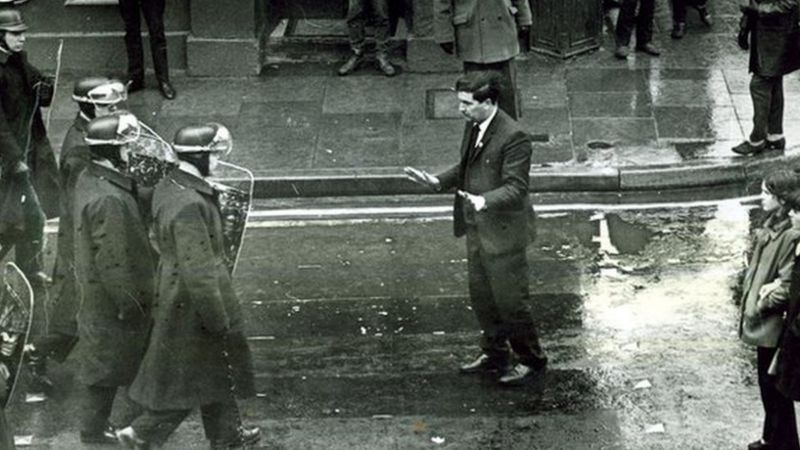
Northern Ireland in the mid 1960s was a powder keg. Ever since partition in the 1920s, the unionist majority, predominantly Protestant, had clung to their overwhelming power in part by political manipulation to exclude the nationalist, mainly Catholic minority, from jobs, housing, and the equal right to vote. Slight moves by the governing Ulster Unionist Party to improve the lot of nationalists had produced a hysterical reaction from some unionists, including Ian Paisley. On the other side of the divide, various civil rights movements were starting to spring up, advocating civil disobedience, inspired in part by the images from the Deep South of the United States.

One of those who joined the Derry Citizens’ Action Committee was teacher John Hume. Hume was elected to the Northern Irish Parliament as a nationalist, and helped to form the moderate nationalist Social Democratic and Labour Party in 1970. He was present at marches against internment without trial, and against the increasingly heavy-handed police and army actions of the early 1970s.


 The street politics of Derry, late 1960s and early 1970s
 
The future of the nationalist movement did not look to be in electoral politics. What had begun as street protests and marches for better conditions was rapidly descending into armed conflict, as hatred at the Stormont government, the police, and increasingly the army was fuelling the rise of the Provisional IRA. Equally appalling was the actions of loyalist paramilitaries, who used fear of the IRA to justify appalling sectarian killings. At times, Northern Ireland seemed to teeter on the brink of total collapse. It was a hard time to be calling for peace and reconciliation.

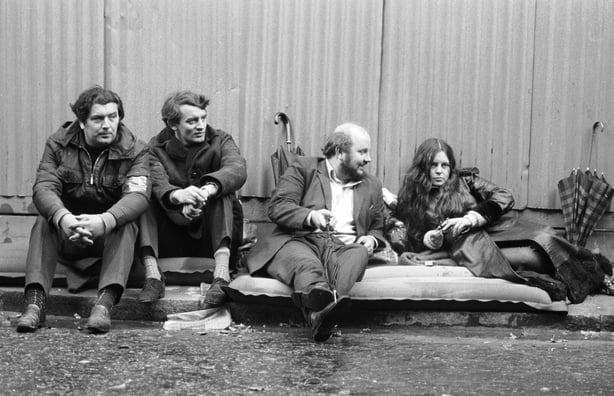
Hume stuck to his (metaphorical) guns. He joined a hunger trike and sit in outside Downing Street in 1971, to highlight the plight of nationalists suffering at the hands of the Stormont administration. He was part of the team who helped to negotiate the Sunningdale Agreement in 1973, a false dawn of power sharing even as the carnage escalated. After becoming an MEP in 1979, and an MP in 1983, he cultivated links with the Irish-American political community, seeing the advantage that American influence would bring. Margaret Thatcher said the landmark Anglo-Irish Agreement of 1985, which conceded that the Republic of Ireland had a role to play in the future of Northern Ireland, was brought about in large part by American pressure.


From Downing Street sit in to the Oval Office

But it is for his willingness to talk to anyone who could bring about peace, even at risk of talking to those who would murder, for which John Hume will be remembered. In 1988, in an incident which seemed to be the very depths of depravity, mourners at an IRA funeral were killed by a loyalist gunman. At their funerals, two soldiers who drove into the procession were dragged from their car and beaten to death in the street. A picture of a Catholic priest kneeling over the soldiers, administering the last rites, was beamed around the world, epitomising the abyss into which Northern Ireland had sunk.

In the pocket of Father Alec Reid was a letter. It was from Gerry Adams, the leader of Sinn Fein, the political wing of the IRA. At the time, Adams was seen as so dangerous, so vile, that his voice was not allowed to even be heard by the British people, to deprive him of the "oxygen of publicity," as Margaret Thatcher put it. The letter was being sent to John Hume. Two less likely allies couldn't be imagined. But, thanks to the work of Father Alec Reid, the two men were corresponding. The letter set out the position of Sinn Fein for an end to the 'armed struggle,' and asked the SDLP leader for his take on them. It marked the start of the ‘Hume-Adams process,’ by which the IRA and Sinn Fein were gradually nudged away from the Armalite and towards the ballot box. First of all in secret, then in the open, these talks helped to persuade the IRA to declare a ceasefire in 1994. Unionist fury and scepticism was seemingly confirmed when the ceasefire collapsed in 1996, with a huge bomb in the London Docklands. But Hume kept going, amidst the derision.


It took a new government in Westminster in 1997, with a large enough majority to not be beholden to unionist votes, for the Northern Ireland peace process to really get going. I’ve told that tale before, so won’t do so again. But it was John Hume and David Trimble who shared the Noble Peace Prize in 1998, not Adams or McGuiness.


The years since have not been kind to Hume, or the SDLP. He suffered from the onset of dementia, to the point that he had no memory of his role in the history of the 20th century. The SDLP has seen itself overtaken by Sinn Fein, the former hardmen of violence, as the main party of nationalism in Northern Ireland. But the very fact that disagreements in Northern Ireland are played out politically, and not with bullets and bombs, is testament to the lasting impact of people like John Hume, who imagined and argued for a world of peace when it seemed virtually impossible to attain.

My feedback for that lesson largely consisted of outlining this story. And telling my trainee to think before he blurted out such sweeping statements. I feel that the former teacher, turned politician and Nobel Peace Prize winner, would have approved.


https://www.theguardian.com/commentisfree/2017/nov/20/john-hume-steered-northern-ireland-peace-process For the views of the late Seamus Mallon, that other senior SDLP giant, and his take on the significance of John Hume.

Friday, 22 May 2020

The Road to Jerusalem

On 22nd May 1960, an El Al flight from Buenos Aires, via Senegal, arrived in Israel. One of the flight attendants had to be carried off the flight by his fellow passengers. Not because he was drunk, but because he was drugged. He had been kidnapped.

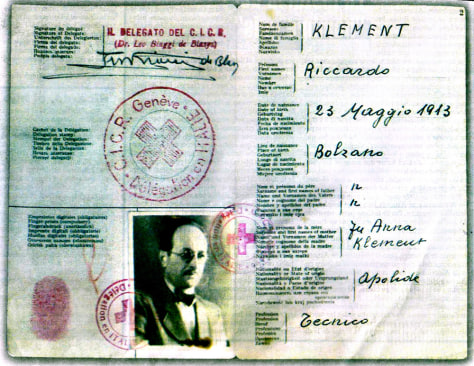
Ten years earlier, he had arrived in Buenos Aires, the capital of Argentina. He had a Red Cross passport. The name on the passport was Ricardo Klement, and it said he was from the Italian Tyrol. There was nothing suspicious about this. Since the end of the Second World War, many from the former Axis powers had migrated to South America. Argentina in particular had a large expat community, and so was an obvious location for those wanting to start a new life.

 Red Cross passport of Ricardo Klement

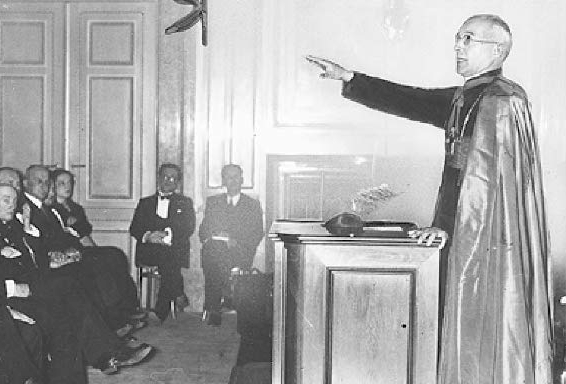
And yet, not all was as it seemed. The passport had been issued under the authority of an Austrian Catholic Bishop, Alois Hudal. Once a rising man in the Vatican, he had been a prominent supporter of National Socialism, and with the Nazi experiment now in ruins, Hudal was very much out of favour. He had turned to providing “a charity to people in dire need.” What he was actually doing was helping Nazis and their fellow travellers to escape. Across Europe, the Allies, and the new states born out of the ashes of a defeated Europe, were engaged in denazification, and trying to bring those responsible for war crimes to some sort of justice. Thanks to Hudal, and those like him, around 9000 former Nazis made it out of Europe and across to South America, the bulk of them to Argentina. These were known as the ratlines.


Hudal, lecturing on Nietzsche in 1937. Pretty much the most Nazi thing imaginable

Further mystery surrounded the man who stepped off the boat in Buenos Aires that July morning in 1950. His passport gave his name as Ricardo Klement, and that he came from a German speaking part of Italy. Yet when he had approached Hudal’s organisation for his papers, his name had been Otto Heninger, and he had been living in northern Germany, working in the forestry industry. Before that, he had been a prisoner of war, and before his escape from an American prison camp he had gone by the name of Otto Eckmann. Travelling to South America on a forged passport, issued by a Nazi sympathiser, and with a string of false identities behind him, Ricardo Klement was clearly a man with a past.

Klement’s family came to join him in 1952, and after several years of working low paid, menial jobs, he eventually got a job with that most German of companies, Mercedes-Benz, working his way up to be a department head. Here the story could have ended. But it didn’t.

On 11th May, Klement got off the bus on his way home from work. He was approached by a man who asked him, in Spanish, if he had a moment. Klement, nervous, tried to walk away. Suddenly, two other man appeared. There was a struggle, but eventually Klement was overpowered and shoved into the back seat of a nearby car.

All because a young man had got himself a girlfriend.

Klaus loved to boast to Sylvia that his father had been a great war hero, helping Germany to accomplish great deeds. Yet no one knew where his father was, he told her. That was why he lived with his uncle, Ricardo Klement.

What Klaus was not to know was that Sylvia’s family was German-Jewish; her father, Lothar Hermann, had been imprisoned in Dachau, and upon release in 1938 had fled to Argentina. Lothar alerted a West German prosecutor that he believed his daughter had found a relative of a senior Nazi holed up in Argentina. Lothar than persuaded Sylvia to undertake an act of monumental bravery. She was to visit Klaus at home, and try to meet his uncle. This she did, but when she called at the house, Klaus was not home yet. Instead, she was invited in by Ricardo Klement. When Klaus returned, not knowing that Sylvia was there, he addressed Klement as father.

Lothar Hermann was stunned. For if Ricardo Klement was Klaus’ father, that meant they would share a surname. Eichmann. This meant Ricardo Klement was one of the most wanted men in the world.

The true past of Ricardo Klement

In the aftermath of the Second World War, the Allies had put the most senior Nazis on trial. But during their testimony, they realised they were missing other monsters. One such monster was Adolf Eichmann. Before the war, he had been involved in Nazi efforts to expel Jews from Germany. When it became obvious that this plan would not work, the Nazi regime embarked upon the Final Solution; the mass murder of European Jewry. The plan which emerged from the Wannsee Conference in January 1942 was to build a network of camps, purely for the purpose of murdering Jews and other untermenschen (sub humans). These camps are now infamous reminders of the horror of horrors. Auschwitz-Birkenau. Treblinka. Belzec. Sobibor. The enormous administrative task of identifying people and transporting them to these camps was to be organised and co-ordinated by Eichmann.


List from the Wannsee Conference, setting out the Jewish population of Europe

His full role was not really identified till after the war, when his name came up again and again at various war crime trials. But by then, it was too late. Eichmann had slipped through the net, and made it to Argentina.

Lothar Hermann passed the information on to the West German prosecutors. But they were afraid; if they launched a formal investigation, Nazi sympathisers in the office might tip Eichmann off and allow him to melt away again. So they passed the information to a group of people who were very interested in getting their hands on Eichmann.

The revulsion and disbelief at the horrors of the Holocaust had been largely responsible for the creation of the State of Israel in 1948. It was the defining experience of Judaism in the modern era. When the Mossad, Israel’s intelligence service, was tipped off that the man who had orchestrated the practicalities of mass genocide was living quietly in Buenos Aires, they swung into action.

A few weeks of surveillance in early 1960 confirmed that they had the right man. But they also had a problem. Argentina had routinely turned down extradition requests for Nazi war criminals. If Israel unveiled Eichmann’s existence to the world, Argentina would drag its heels, and again the world’s most wanted man would slip away. Eventually David Ben-Gurion, the Israeli Prime Minister, authorised the only option open to Israel; Eichmann was to be kidnapped. The director of the Mossad flew to Buenos Aires himself to lead the mission.

After he was snatched from the streets, Eichmann was questioned in a Mossad safe house. They were confident they had the right man. The Mossad team also learnt that Eichmann knew the location of Joseph Mengele, the so called ‘Angel of Death’ who had carried out human medical experiments in the death camps. They paused to watch this new location for a few days. But Mengele had recently moved out of this boarding house, and no one knew where he was. Deprived of a double capture, the team now needed to get Eichmann out. His family had searched the hospitals of Buenos Aires, but had not yet informed the police of his disappearance. But the Mossad team could not afford to wait much longer.

Argentina was celebrating 150 years of independence from Spain. A large team of Israeli diplomats and politicians had flown in to mark the occasion. When they flew back out again, to Senegal to refuel and then on to Israel, the team was slightly larger. And one of the flight attendants looked very much worse for wear.

On 23rd May 1960, David Ben-Gurion announced to the Knesset that Israel had acquired Adolf Eichmann. The reaction of the members, often at loggerheads with each other, was estatic. The Argentines, on the other hand, were livid at the infringement of their sovereignty. The West Germans and Americans panicked, worried that Eichmann might implicate senior Nazis who had survived denazification, and were currently working for them. For Eichmann himself, his biggest moment was yet to come, when he would face trial in Jerusalem.

Eichmann in Jerusalem. A tale for another time

Thursday, 7 May 2020

Why what you know about VE Day is (probably) wrong

This year marks 75 years since VE Day, the end of the Second World War in Europe. As with most historical events, everyone 'knows' what happened. As with most historical memory, what you think you know isn't the full picture...

Celebrations

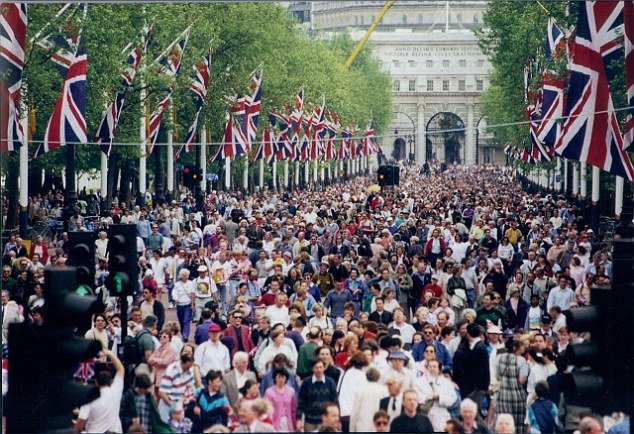
We've all seen the pictures. People celebrating, dancing in the streets, crowding central London to hear Churchill and the King speak and appear on the balcony of Downing Street. And with good reason. After six years of hardship, and having been expected imminently over a week, the Second World War in Europe was at last at an end.


And yet...

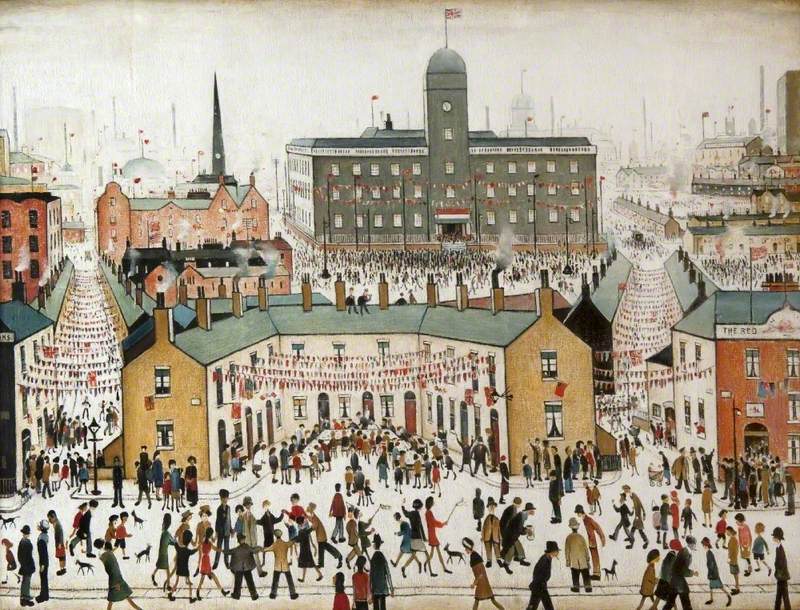
All of this did happen, that is beyond dispute. But away from most city centres, VE Day was a quiet day. "Usually, crowds were too few and too thin to inspire much feeling," reported Mass Observation. In the afternoon and evening, between 33% and 40% of the adult population was inside, tuned to BBC Radio, listening to coverage of various speeches, church services, and what we would now call vox-pops. In L.S. Lowry's VE Day, the side streets are deserted.


Many people found the whole atmosphere a bit artificial, a bit forced. The author Vera Brittain reflected that it was not as spontaneous as the end of the First World War 27 years previously. This makes sense. For many people, the war had become normality. VE Day marked the first jarring step into the unknown.

In popular memory, it was the hero of the hour, that icon of Britain at war Winston Churchill, that people were keenest to hear from. And yet, Mass Observation recorded some people treating his speech about the future with derision. "It was just like this after the last war and twelve months later we was standing in dole queues" a middle-aged man was heard to say when Churchill made positive noises about rebuilding the country. And although he was hushed by those listening to Churchill's speech ("He's done a grand job of work for a man his age - never sparing himself"), Churchill was living on borrowed time. Within weeks he would prove he was not the man to lead Britain into the brave new world. Forced into an election campaign, he said that his war cabinet colleagues would need a Gestapo to make their planned welfare state work. Churchill led the Conservative party to a crashing defeat, and was replaced by Labour's Clement Attlee. With this piece of knowledge, maybe it makes sense that the popular, unpolitical King George VI was the person people wanted to hear from the most on VE Day.

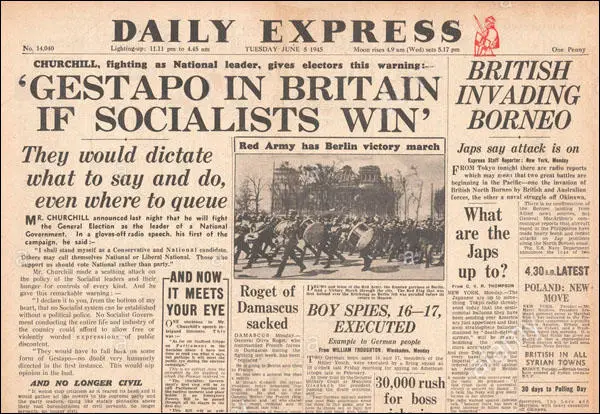
The two sides of Winston Churchill in 1945: heroic war leader to bungling party politician within a month

We won

I mean, on the face of it, yes. Britain was on the winning side. And what we had helped to defeat was the epitome of political depravity and evil. The evidence for that was evident, from the death camps of the Final Solution that were liberated as the war drew to a close.

But victory had come at a price. In 1815, relaying news of his victory at the Battle of Waterloo, the Duke of Wellington had said:

My heart is broken by the terrible loss I have sustained in my old friends and companions and my poor soldiers. Believe me, nothing except a battle lost can be half so melancholy as a battle won.

This is a pretty good summary of the place the United Kingdom found itself in in 1945. Yes, it had won. But at great cost. Around 384,000 British servicemen and women had been killed, and another 376,000 injured. 67,000 civilians had been killed, mainly in the bombing of British cities between 1940 and 1941. The country had bankrupted itself in this fight to the death with Nazi Germany, and was reliant on cheap loans and handouts from other countries, particularly the USA. It would now have to rebuild Britain, and pay its share of rebuilding Germany, with empty pockets.

The psychological damage to Britain's place in the world was also profound. For the Britain of 1945 was not just the United Kingdom we know today. It encompassed a quarter of the world's land mass, and one in five of every person alive in 1945 was a part of the British Empire. But Britain's position as the pole imperial power was badly shaken. It had been the colonies and Dominions of the Empire which had rescued us just as often as the other way round. The speed with which France had fallen, and the British withdrawal from it, the ease with which the HMS Repulse and Prince of Wales had been sunk, the falls of Singapore and Hong Kong to the Japanese, the fact that the Channel Islands had been occupied and not freed until after the war was over, all had shattered the image of British imperial might. Britain's treatment of the empire's brightest prize did not bear close scrutiny. The Bengal Famine of 1943-44 was made worse by the focus of the British Indian government on fighting the Japanese, and there was a crackdown on the Indian National Congress by the authorities. Within a decade and a half, the British Empire would be no more. It is telling that the contribution of the colonies in saving Britain from Nazi Germany has virtually not featured in our telling of the story of the Second World War. It is too painful, too unlike the story we tell ourselves.

Soldiers of the British Indian Army, 1944. They are often omitted from our story of the Second World War

It is often said now that the USA contributed the most money and industrial money to the war effort (the US economy only emerged from the depths of the Great Depression thanks to the Second World War), the USSR the most manpower (somewhere between 20 and 30 million Soviets died in the war), and Britain provided the most brains and innovation. A simple glance at the shelves in any bookshop, with titles like Churchill's Boffins, or recent films and TV shows about Alan Turing and Bletchley Park, will show this approach. And it is true that some technological advances were designed with the help of British scientists, notably the atomic bomb. But it does offer a telling glimpse of the reality of the postwar world. The future belonged to those two superpowers who had dominated the war effort. Britain was now very much going to play third fiddle on the world stage.

 
Part of the myth that we tell ourselves is that our brainpower helped win the Second World War

Britain did emerge from the war with immense moral authority. After all, it had stood alone in 1940 and 1941, carrying the flame of resistance and hosting the governments in exile, as country after country was plunged into Nazi occupation. Even this is contentious history, as many politicians in 1940 were prepared to talk peace with Hitler (it has to be said, amusingly given the regularity with which they reach for the imagery of the war, many senior Conservatives, often the ones who had resisted Churchill's ascent to the premiership), the USA was already bankrolling Britain by that stage, and it ignores the support of Greece and Yugoslavia, countries we notably failed to save from Nazism in the spring of 1941. But rightly or wrongly, Britain did get moral credit. It was to waste much of that in 1956, during the humiliation of the Suez Crisis. Some victory indeed.

War's over

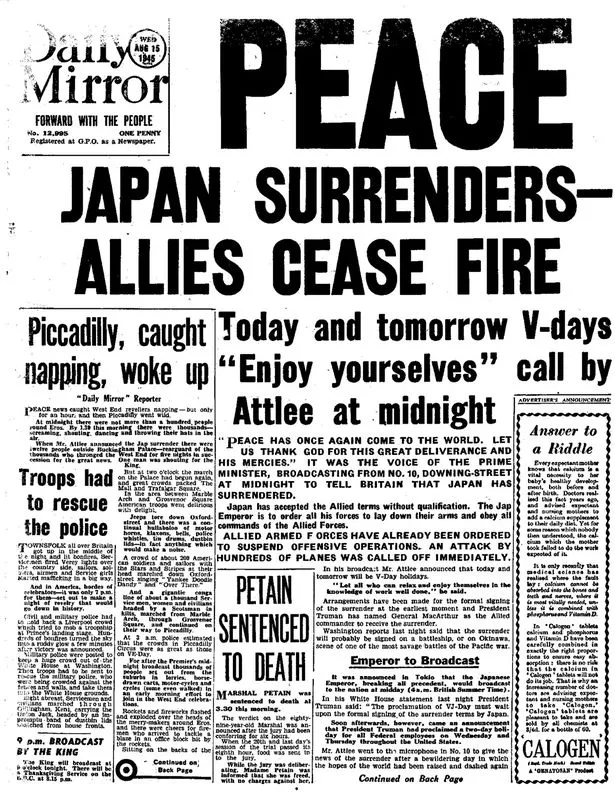
VE Day is often held up as the end of the Second World War. It really wasn't. In the Far East, Imperial Japan still controlled vast swathes of Indonesia, the Philippines, Pacific Islands, and China. Japanese attitudes to surrender were that it was a huge dishonour. Already, even turning the tide against Japan had been far bloodier than much of the fighting in Europe. The Americans were closing in on the Japanese home islands, but the war was far from over.

There were three alternatives open to the Allies. One was to starve Japan into submission, by using their navies to sink ships transporting food between the four main islands. 67 of Japan's cities had already been subject to firebombing; this would be intensified. The second option was to invade Japan itself. Given the ferocity of the fighting so far, the casualty estimates sometimes ran into the tens of millions, when taking in Allied servicemen, Japanese soldiers and civilians. Also, there was no guarantee that the Japanese wouldn't just move the Emperor elsewhere and carry on the war. For soldiers in Europe, being held to prepare to transfer to Japan ahead of the planned invasion, there was genuine fear. Certainly, many people looked grimly at the Far East and expected several more years of carnage.

So the third option was taken. On August 6th 1945, the Japanese city of Hiroshima was obliterated in a blinding flash of light. Three days later, Nagasaki was also destroyed. Japan, facing the full horror of warfare in the new atomic age, decided to surrender. There were more celebrations around the world for VJ Day. At last, the war was truly over.

The true end of the Second World War(?)

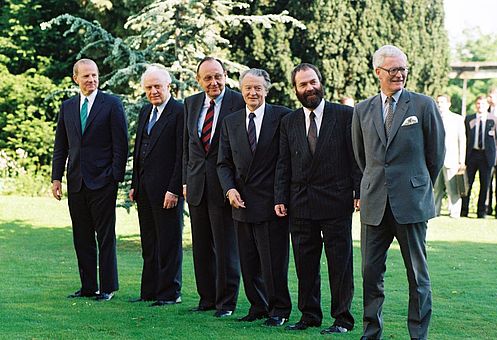
Even this isn't so simple. The Second World War may have been over. But the one thread which held the Allies together was defeating Nazi Germany, and Imperial Japan. With these enemies vanquished, it became rapidly apparent that the USA and USSR would not get along. For another 45 years, the spectre of a war between these two would haunt the world. And many people would die in the conflicts fought by their proxies. In the celebrations of VE Day, it is possible to see the Cold War which would dominate the world until 1990.

The signing of the final German peace treaty, in September 1990, at the end of the Cold War

The army which fought the war in the Far East for Britain is often called the Forgotten Army. The army which fought in Burma and Malaya does not attract the same attention as the fighting which took place in Europe and North Africa. The focus on VE Day shows this. But this was not the end of the Second World War, and we would continue to live, and fight, in the world it created for a long time to come.

Commemoration

All of these confused memories aside, we have decided to commemorate VE Day. This is fairly novel. We did not make this a big deal of the anniversary in 2015, or 2005. The Bank Holiday was moved for the 50th anniversary of VE Day in 1995. This 1995 event is important, for it marks the start of the resurgence of war commemorations in Britain. Until the mid-1990s, attendance at Remembrance Sunday events was continuing to fall, Remembrance Sunday itself was the day marked, over Armistice Day. Major anniversaries, of battles and events, were marked, but not to anywhere near the same extent as they are today.

VE Day's 50th anniversary in 1995- the start of Britain's rememberance mania
Whereas now, we are in a very different landscape. Remembrance Sunday has become a major event on the calendar, and more attention has turned to Armistice Day, to the extent that both are now marked in the same week with silences and ceremonies. The recent passage of the centenary of the First World War saw a wide range of events, and the Second World War does too. It has become heresy to suggest that these events cannot be commemorated, celebrated even, on a large scale.

Our commemoration has increased at the same time as the number of people who were there has gone down. To take the Second World War, these events were barely marked through until the 1990s. But there were millions of Britons in the 1950s, 60s, 70s, and 80s who had direct memories of the Second World War, indeed who had fought in the war, yet they chose not to mark these events. It is only with the increasing passing of this generation that our commemoration has gone up several gears.

Part of this makes sense. As there are fewer links to that past, there is more of a drive to connect to it, partly because it is harder for us to associate with it. But this also means the opportunities for mis-remembering are rife. We retreat into a safe, warm, memory, but one which may not really have happened. The current VE Day setup is borderline a festival (albeit one being conducted at a 2m distance). That is not fair to the sacrifices of millions in the Second World War. I often think 'Is this what they would have wanted us to be doing?' Look at the tea boxes full of food they definitely would not have had, the national sing along, containing none of the songs that the radio played on the day, the idea that Churchill was lauded as the nation's saviour when he was weeks away from being ejected from Downing Street in a landslide.

I have really conflicted views on this. I obviously believe the defeat of Nazism was a good thing, and it is important to mark it, and the contribution of those who did it. To borrow the words of the Kohima Memorial, those who gave their tomorrows for our todays. But I am also a history expert, who spent five years studying it at university, and five years teaching it to people. Much of the way we mark these events is what we want to remember, not what really happened. This is bad history. Bad history leads to a bad misunderstanding of the present. And bad history is something the people of 1945 had just spent six years pitted against.

 
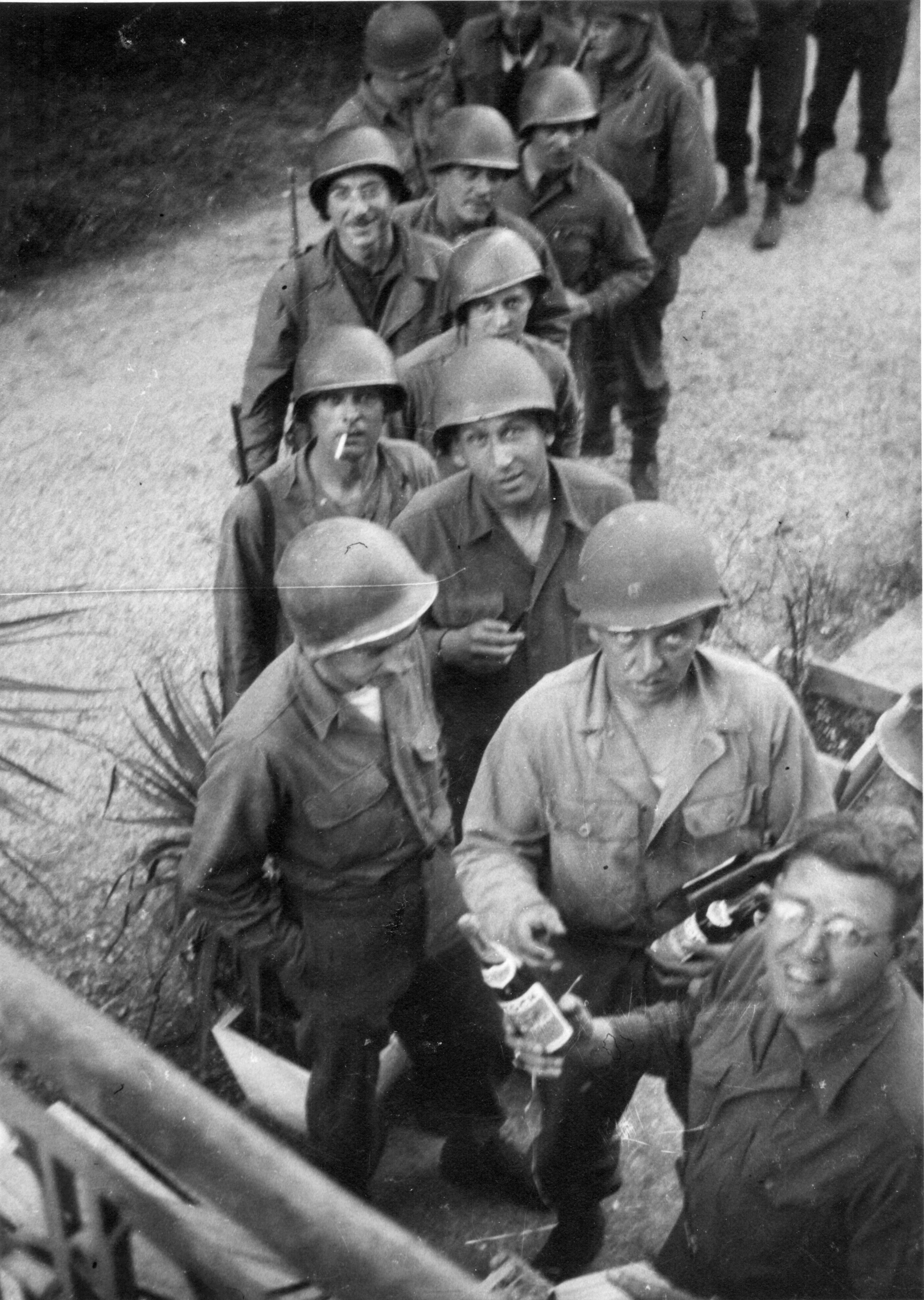
US combat engineers passing out champagne on VE Day, May 1945

Thursday, 30 April 2020

Nazi Germany's Ten Days Without Hitler

By 30th April 1945, it was clear to everyone that the Second World War in Europe did not have long left to run. In the West, the reverse of the Battle of the Bulge in the winter felt like a distant memory. British and American troops were across the Rhine, and driving deep into Germany itself. On the Eastern Front, the Red Army had begun its assault on Berlin, and was fighting house to house in the 'lair of the fascist beast.' Everywhere they went, Allied soldiers were uncovering the true depths of depravity which Nazism represented, as the death camps and concentration camps of the 'Final Solution' were thrown open. Five days earlier, US and Soviet troops had met at the Rive Elbe. Surely, the end had to be in sight.

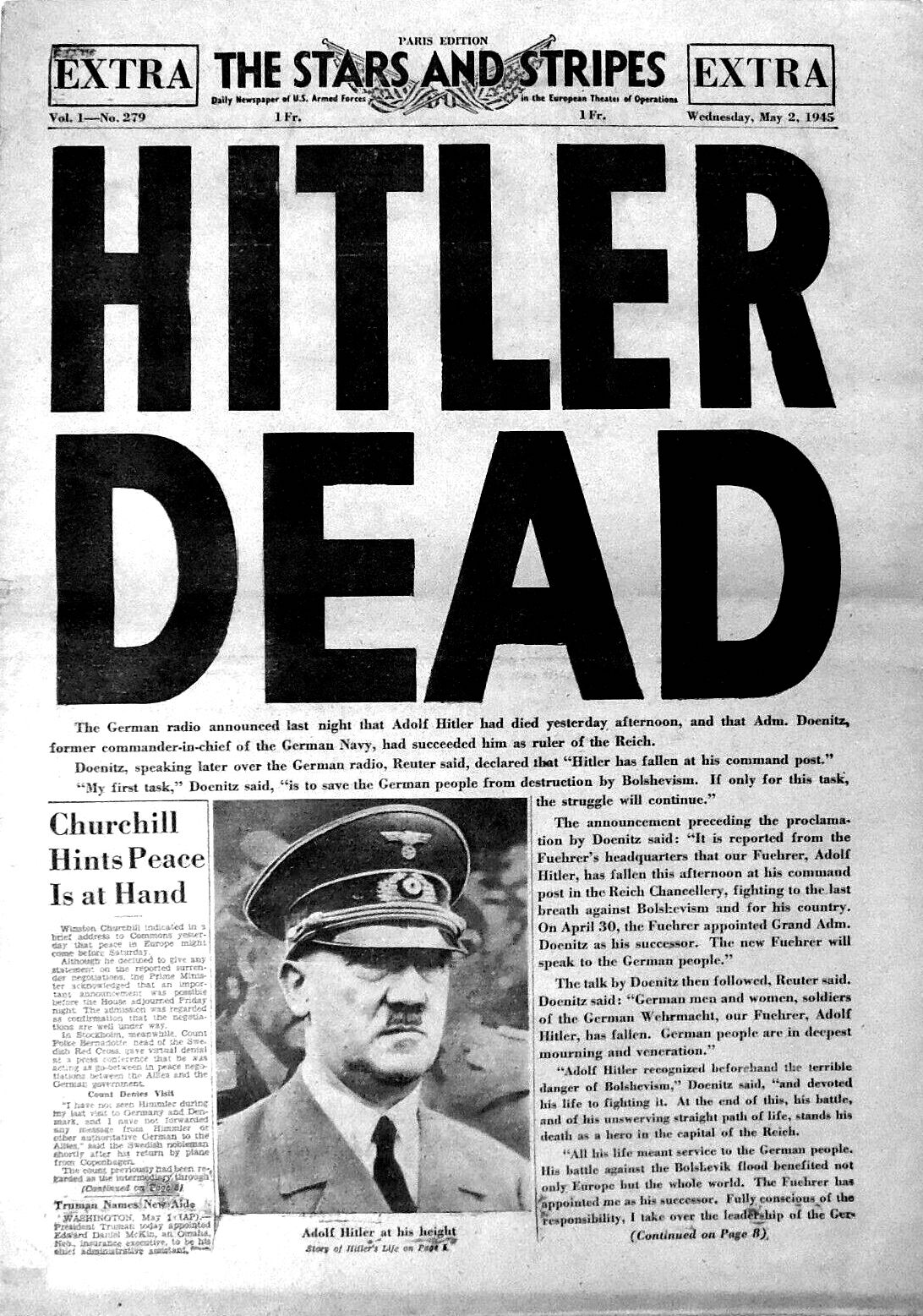
Then, on 1st May 1945, Hamburg radio began broadcasting a newsflash. Adolf Hitler, the Fuhrer of Germany, the man who embodied the Nazi party and state, was dead. He had actually been dead since the previous afternoon. After dictating his last will and testament, Hitler had committed suicide, along with his new wife, Eva Braun. Their bodies had been burnt in the garden of the Reich Chancellery. The man often identified as the epitome of evil in history was no more.

 The news everyone had been waiting for- but the war was not yet over

Yet for ten days, the Third Reich fought on. Nazi Germany was a state built around 'ein volk, ein reich, ein fuhrer,' but somehow it staggered on without its supreme leader, or for that matter many people or much of an empire.

In the days running up to Hitler's demise, the struggle to succeed him had raged inside the Nazi machine. Hermann Goering, Hitler’s designated successor, had telegrammed Hitler on April 23rd asking for permission to assume power, in effect trying to remove the besieged leader. Five days later, the head of the SS, Heinrich Himmler, was revealed to have approached the Swedish government to act as a peace broker between Germany and the Western Allies. Outraged, Hitler sacked both Goering and Himmler, declaring both to be traitors. In his last will and testament, Hitler ended the office of Fuhrer, dividing it back into the Chancellorship and the Presidency, which had been the situation during the first year and a bit of Hitler's rule, when President Hindenburg was still alive. It was to another military leader that Hitler turned; Grand Admiral Karl Doenitz, the leader of the German navy, would become President, and Joseph Goebbels, the director of propaganda, would become Chancellor.

Goebbels’ Chancellorship lasted a little under 24 hours, before he too committed suicide in the Fuhrerbunker in Berlin, along with his wife; they also murdered their six children. This left Doenitz as the last Nazi standing. From his headquarters at Flensburg, he became the President of the German Reich and the commander of the armed forces.

The new leader of Nazi Germany, Grand Admiral Karl Doenitz
 
By this stage, the German armed forces were the only arm of the state that continued to function. The civilian ministries had been scattered across Germany during the chaotic exodus prior to the Battle of Berlin, and many government ministers were in effect running German life on paper only. But the armed forces were still responding to orders, albeit close to collapse. It was to them that Doenitz spoke first. He urged them to continue to fight.

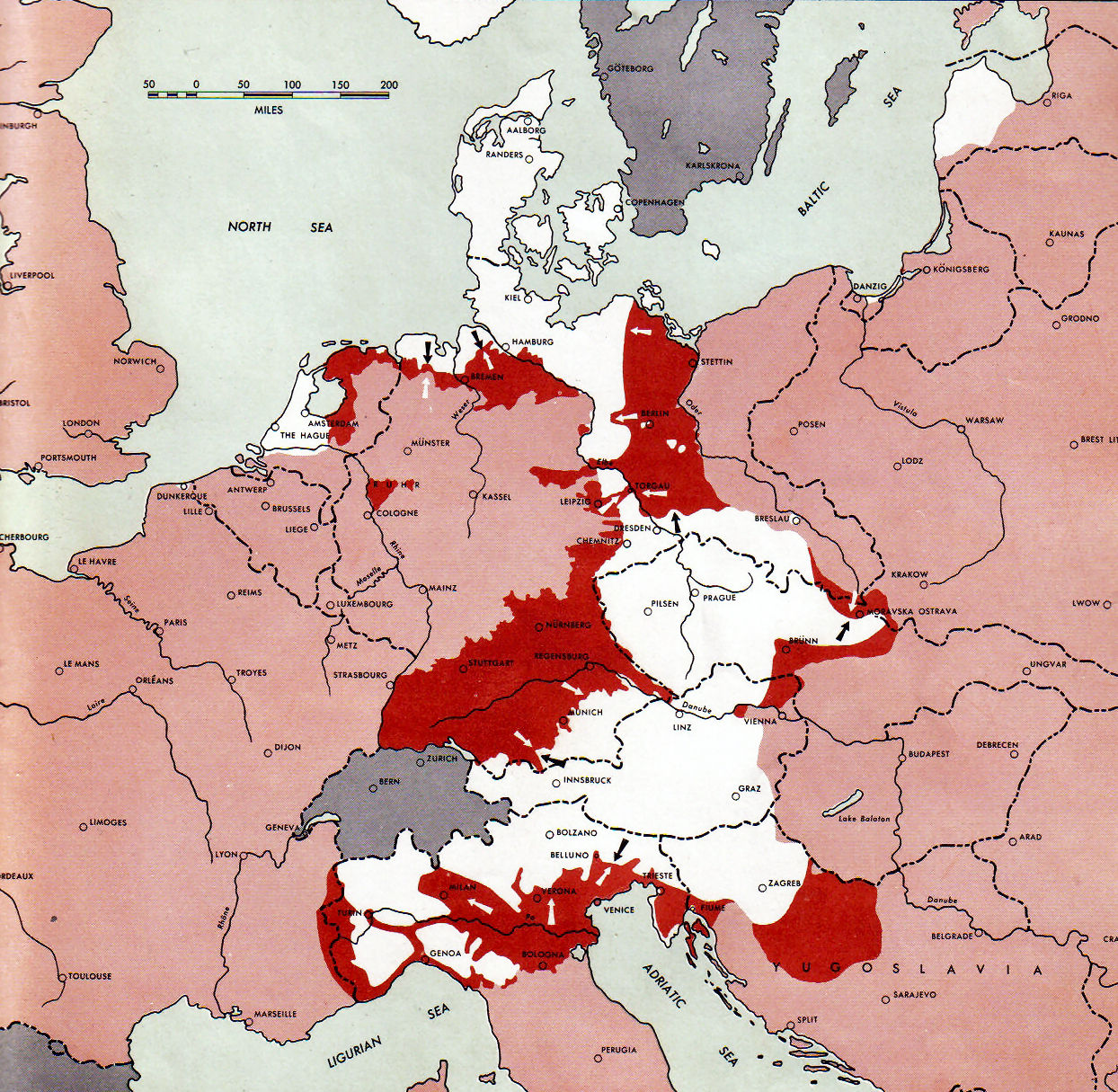
At the time of Hitler's death, the white bits were the extent of Nazi control; being Fuhrer wasn't as attractive a job prospect by this point...

Not because he expected to win. Rather, Doenitz's policy was to hold off the Soviets for as long as possible, while entering into localised negotiations with Western Allied commanders. The hope was that conducting separate peaces would make the Western Allies fall out with the USSR, and they could then unite with the Germans in an anti-Communist crusade. In case this fantasy didn't work out, Doenitz's other objective was to surrender as many soldiers to the West as possible; the savagery of Wehrmacht atrocities in the USSR meant that there would be no quarter given by the Soviets, even in defeat.

This also explains Doenitz's decision to exclude prominent Nazis from his government. Apart from Albert Speer, none of the new ministers had been notable in the Nazi government so far. The SS and other organs of the Nazi party were kept at arm’s length. The idea was to present a new face, one which the Western Allies could do business with.

The changes were only cosmetic. The Hitler salute and greeting continued, a bust of Hitler remained in Doenitz's office, and the Nazi party remained in existence. The Nazi system of summary justice carried on, and around 10,000 concentration camp prisoners remained in the hands of the SS. This was business as usual.

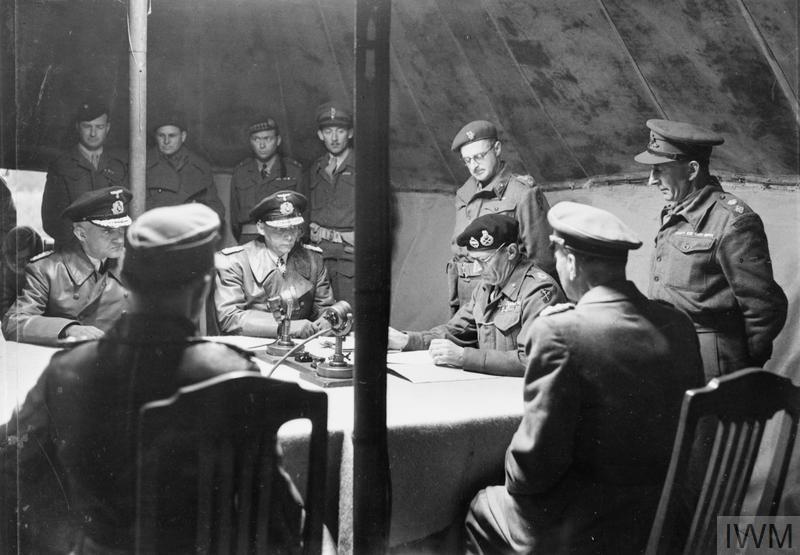
It even looked as if the plan would partially succeed. Doenitz's representatives met the British general Bernard Montgomery, and offered to surrender all Wehrmacht forces in north-west Germany to him. Montgomery refused to accept that, but did hint he would accept the surrender of any forces fleeing the Eastern Front. The deal eventually hammered out with Montgomery and Dwight Eisenhower, the Supreme Allied Commander, was that on 5th May, all German forces in north-west Germany, Denmark and the Netherlands would surrender to Britain and America. On 6th May, all German forces in Bavaria and the south west would surrender to the Americans. Doenitz also began talking to the US General George Patton, whose forces were racing through Czechoslovakia. The idea was to surrender German forces fighting on the Eastern front to Patton, and enable him to enter Prague. Patton was famously anti-communist, and the USSR had already been promised control over Czechoslovakia at the Yalta Conference. He had been approached deliberately to cause maximum rage in Moscow.

Montgomery has a reputation for being prepared to play the media game. This time, he didn't play it well enough. He failed to put out a version of the surrender order. Doenitz and the Germans spotted this gap and published their own interpretations of what had been agreed. As well as disagreeing over warships and areas to be surrendered, it described the agreement as a truce, not a surrender. A pause in the fighting, not an end to the fighting. It looked to all the world as if Britain and America were conducting talks with the Nazis and excluding the Soviets.

Montgomery accepting the partial German surrender at Luneburg Heath; this act caused chaos amongst the Allied leadership

Too late, Eisenhower spotted the trap. He forbade any further partial surrenders like this. Patton in particular was ordered to halt his advance into Czechoslovakia, despite howls of anguish from Patton at not being able to support the Czechoslovak resistance battling for control of Prague. In Moscow, Stalin was livid. Could it really be that, at this 11th hour, the West was going to betray him? Would they soon be joining with the Nazi remnant for a new war against communism?

When German representatives went to Reims in France to try and surrender wholesale to the Western Allies, Eisenhower was ready for them. He refused point blank to accept any surrender that did not include the USSR. Doenitz told his representatives to stall, to give him time to pull as many forces and refugees away from the Red Army and into the arms of the West. When this became obvious, Eisenhower told the Germans he would close the Western Front to new arrivals, and fire on anyone trying to cross. This would leave the Wehrmacht trapped between the Western Allies and the Red Army, with no alternative but slaughter. When Doenitz was told this, he agreed his representatives could sign the deal, and that all units would surrender at 23:01 on 8th May 1945.

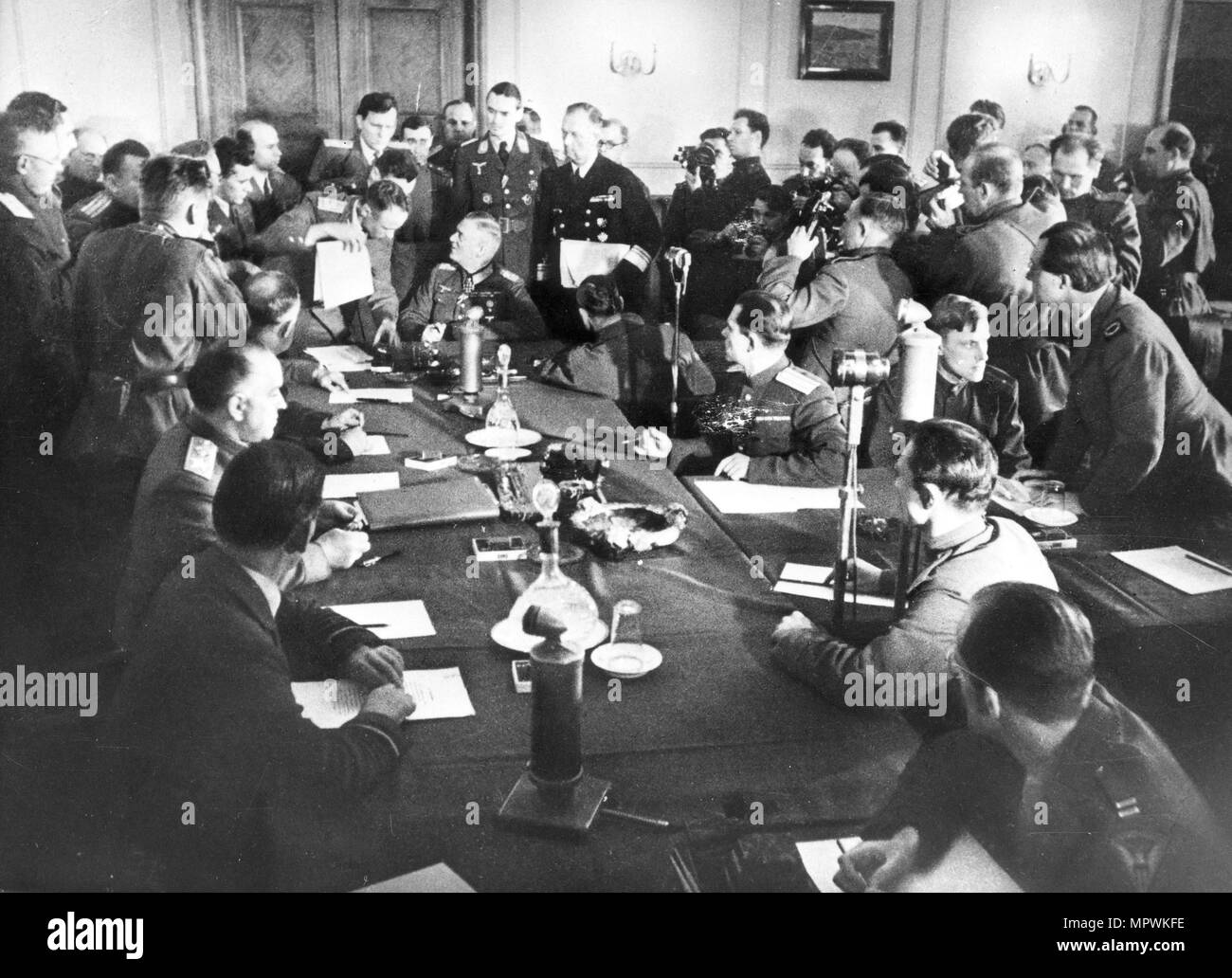
But this still wasn't the end. There was confusion over whether the Soviet delegate could sign the agreement, and then Moscow protested that Doenitz was still continuing to withdraw units westwards away from the Red Army. The surrender document was amended, and was signed not by Doenitz but by the heads of the three German armed forces. It still went into effect on 8th May 1945: VE Day, although by Moscow time it was the 9th. But it was of no importance when it was. The war in Europe was over. The ten days in which Nazi Germany fought the war without Adolf Hitler at the helm were at an end.

The second signing of the German Instrument of Surrender. Second time lucky...

Incredibly, this still was not the end of the Flensburg government headed by Doenitz. It staggered on until 23rd May, ignored by the Allies, but still meeting every day in a school sports hall, discussing matters such as the reconstruction of Germany. They also messaged Imperial Japan, informing it they would struggle to uphold their end of the Axis alliance bargain.

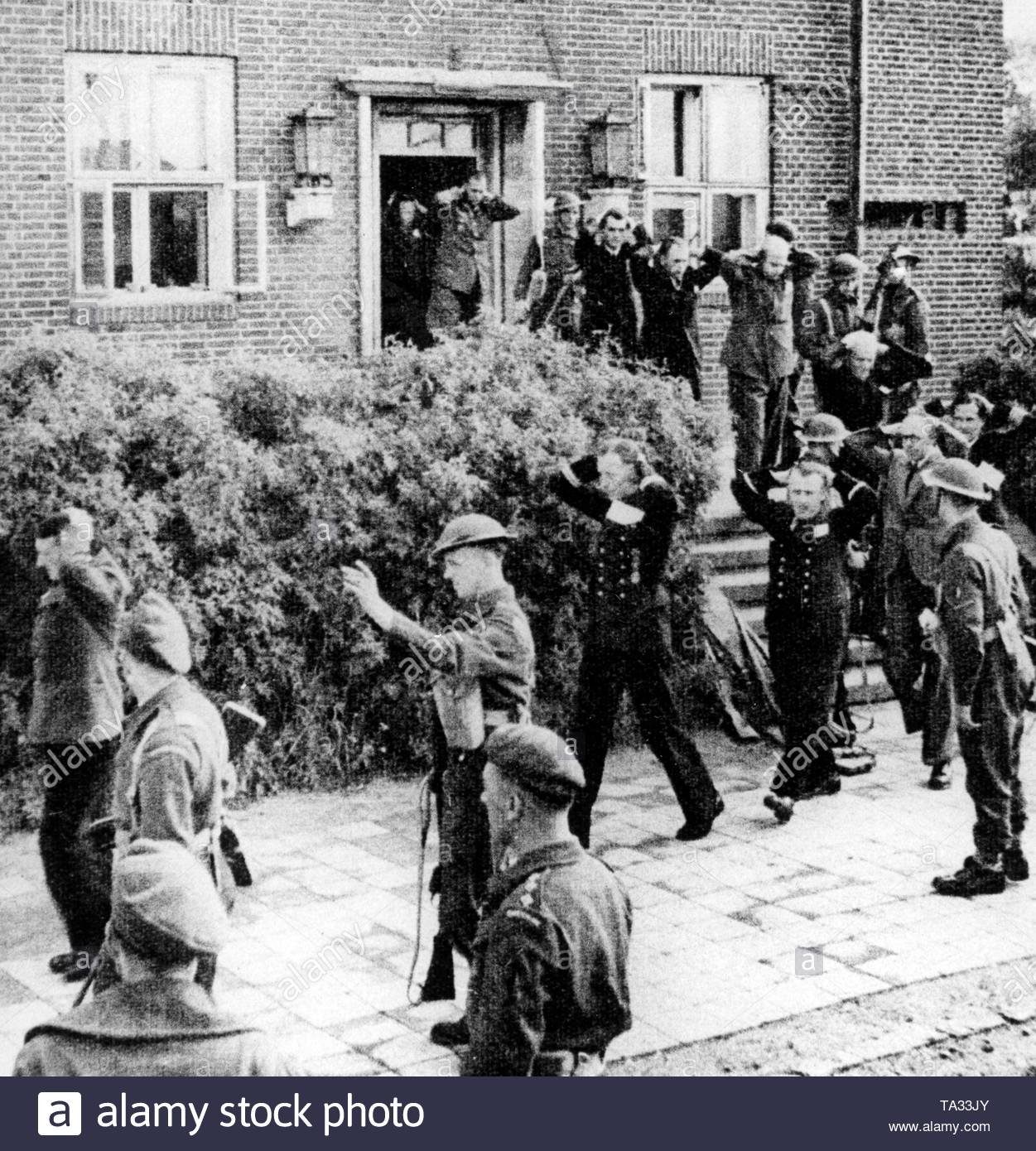
On 23rd May, the game was up for the Flensburg government. Its members were arrested, and on 9th June the four Allies issued a declaration that as Germany had no government, they would assume control over the country for the time being. Planted in this was the seed of the Cold War, and of a divided Europe. The mistrust which came to blight the world in the later 20th century can be seen in the squabbles and arguments over the negotiations with the Flensburg government.

The arrest of the Flensburg government, 23rd May 1945

Another idea which the Flensburg government bequeathed the post-war world was just as sinister. The administration came into being as the true extent of the horror of horrors of the 20th century was being unveiled. The scenes at the camps of the Final Solution prompted revulsion around the world. Doenitz’s government, aiming to be given control of post-war Germany, needed an answer, fast. They blamed the SS, and elements within the Nazi party, for the violence and savagery. The armed forces, had not been to blame. Doenitz himself benefitted; despite being Hitler's chosen successor, he emerged with a good reputation, and thousands attended his funeral in 1980. By downplaying the guilt of the German leadership, and pinning the blame on some bad apples, the 'myth of the clean Wehrmacht,' and the very beginning of Holocaust denial, can just be seen.

One last final way that the Flensburg government impacts Germany today. The surrender document was signed by the German High Command. Technically, no government had agreed to Germany ending the war. The Allies claimed this was because Germany's government had disintegrated in the collapse of the Nazi regime; this is one of the reasons they were so keen to avoid acknowledging Doenitz as President, as it would make their assumption of total power over Germany more awkward if there was still a German government functioning. But it also gave rise to the idea that the German state had never surrendered, and still exists somewhere. In recent years, the German police have struggled with the Reichsburger movement. Their claim? That the German government never surrendered to the Allies, and they are claiming it for their own.